
English Fluency Practice Tracker
Daily Practice Goal
Anxiety Assessment
Shadowing Practice Timer
Record yourself for 5-10 second segments, then repeat immediately.
Progress Projection
💡 Quick Reminders:
- Exposure Therapy: Start small - order coffee, ask questions in low-stakes situations
- Focus on Rhythm: Stress important words (verbs/nouns), let smaller words "fly by"
- Use Circumlocution: Describe unknown words instead of staying silent
- Record Monthly Vlogs: Track improvements you can't notice day-to-day
You know that feeling when you want to say something, but your brain freezes? Your mouth wants to move, yet nothing comes out except a pause. It happens to everyone, even native speakers sometimes. But for non-native speakers, this barrier feels like a physical wall between you and the world. Speaking Englishis a skill that requires consistent exposure and active practice to master fluency isn't just about knowing grammar rules; it is about training your brain to retrieve words quickly. Many people spend years studying textbooks without ever truly opening their mouths. That approach builds knowledge, but it does not build speaking confidence.
We often confuse perfection with progress. You do not need to be perfect to be understood. In fact, striving for perfection is the biggest enemy of fluency. When you worry about making a mistake, you hesitate. Hesitation breaks the flow of conversation. The goal is to communicate ideas clearly, even if the sentences aren't structurally flawless. Native speakers interrupt each other, use filler words like "um" and "uh", and repeat themselves constantly. If you emulate that natural rhythm, people won't notice your minor errors.
The Psychology of Speaking Without Fear
Your brain treats public speaking like a threat. When you stand up to give a presentation or join a group chat, your amygdala might trigger a fight-or-flight response. This raises your heart rate and dries up your throat. To overcome this, you must reframe the interaction. Instead of seeing it as a test where you are being judged, see it as a collaborative exchange of information. You both have value.
Try the "exposure therapy" method. Start small. Order a coffee in English. Ask a shop assistant where an aisle is located. These low-stakes interactions condition your brain to realize that making a mistake has no negative consequences. Most listeners are kind. They want to understand you and help you through the confusion. If you stop fearing the error, your voice will naturally steady.
| The Fear | The Reality | Action Step |
|---|---|---|
| Fear of judgment | Listeners focus on meaning, not grammar | Speak anyway; pause instead of freeze |
| Fear of wrong accent | Clarity matters more than sounding native | Practice stress and rhythm over sounds |
| Running out of vocabulary | Most conversations cover 2,000 common words | Use synonyms or describe unknown objects |
| Fear of long pauses | Thinking time is normal in conversation | Use filler words like "That's interesting" to buy time |
Mastering the Mechanics of Sound
Pronunciation is the bridge between your thoughts and your listener's ears. If your word production is unclear, the listener has to work harder to decode your message, which slows down the conversation. You don't need to lose your accent completely. Accents give you identity. However, you do need to master Vowel Claritythe ability to distinguish between similar vowel sounds clearly. For example, confusing "ship" with "sheep" can change the entire meaning of a sentence.
Rhythm and stress are far more important than individual sounds. English is a stress-timed language. We speed up unstressed syllables and slow down stressed ones. If you pronounce every word with equal emphasis, you sound robotic. Listeners struggle to follow that pattern. Focus on the most important word in the sentence-usually the verb or the noun-and make it louder or longer. Let the smaller words like "the", "and", "of" fly by quickly. This creates the music of the language.
To train this, record yourself reading a short paragraph. Listen to the recording while reading the text along with a native speaker. Note where their voice goes up and down. Match that melody. Your brain learns patterns faster than your mouth can articulate them. Once the muscle memory is there, you don't have to think about the sound anymore.
The Power of Shadowing Technique
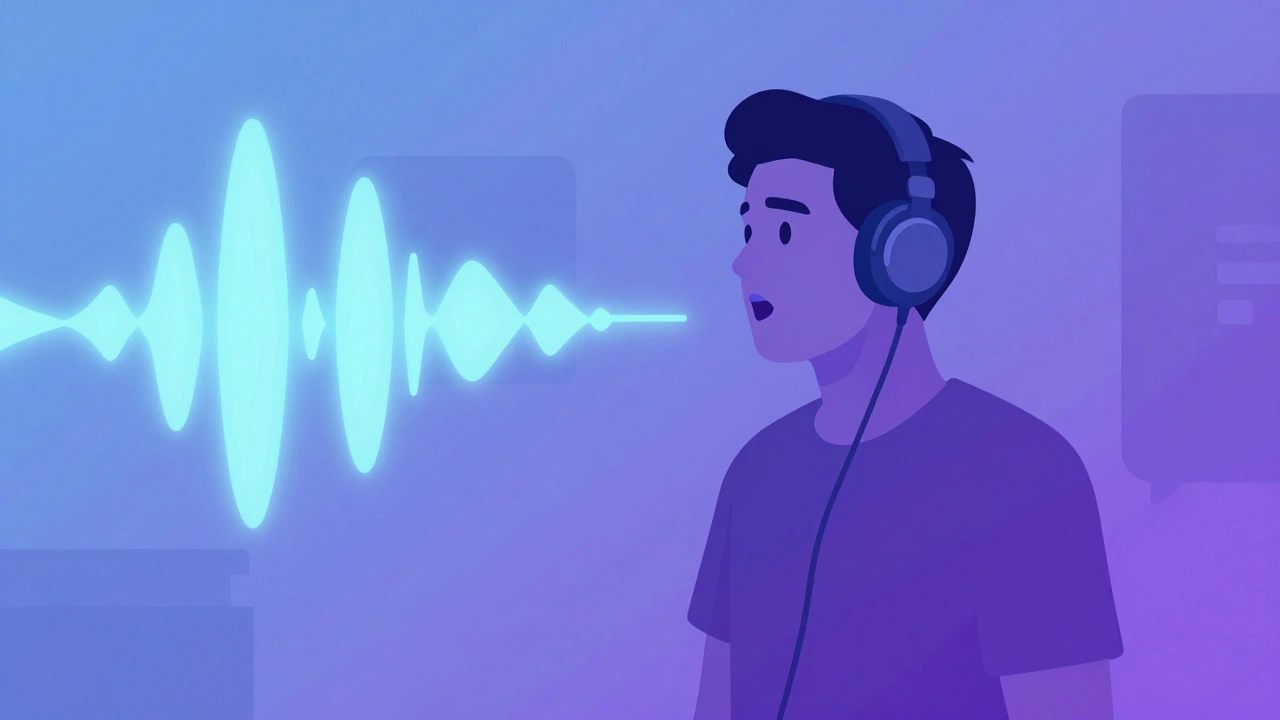
If you are ready to upgrade your input processing, try the Shadowing Techniquean advanced method where you repeat audio immediately after hearing it. This is not just listening and repeating later. It involves playing an audio clip and speaking simultaneously with the speaker. You act as an echo. This forces your brain to process sound and speech production pathways at the same time.
- Find a podcast or video with a clear transcript.
- Listen to a short segment (5-10 seconds).
- Play it again and speak out loud exactly as they speak.
- Copy their volume, emotion, and pauses.
- Gradually reduce the gap between their speech and yours until you speak in unison.
This method trains your vocal cords to handle the speed of native speech. Start with slower podcasts designed for learners, then move to standard news broadcasts. By mimicking the intonation patterns, you borrow the prosody of the language. It feels unnatural at first, but soon you will find yourself using those sentence rhythms in real life without trying.
Bridging Vocabulary Gaps Without Panic
Nothing kills a conversation faster than getting stuck on one missing word. You know what you mean, but the label for that object escapes you. Stop memorizing isolated word lists. Words learned in isolation fade quickly because they lack context. Instead, learn Collocationswords that frequently appear together in natural speech. Learn phrases like "make a decision" or "do homework" rather than just the words "decision" and "homework" separately.
When you get stuck, do not stay silent. Describe the concept. If you forget the word "umbrella," explain "a tool used to keep rain off your head." This strategy is called circumlocution. It keeps the communication channel open. Your partner will likely catch the hint and supply the word you forgot, reinforcing your memory. It turns a potential failure into a collaborative win.
Keep a dedicated notebook or digital note for useful expressions. Review it weekly. Contextual learning ensures that when you hear a phrase in the wild, your brain lights up and recognizes it instantly.

Creating Your Own Immersion Environment
You do not need to live in Manchester, London, or New York to immerse yourself. You can create an artificial environment at home. Change the language settings on your phone to English. Watch movies with English subtitles, not in your native language. If you watch a film in your native language with English audio, you split your attention. If you read subtitles in English, you connect sound with spelling.
Spend thirty minutes a day consuming content you enjoy. It could be cooking channels, gaming streams, or news clips. The key is interest. Boring material leads to burnout. Happy engagement makes repetition feel less like work. Over time, your internal monologue-the voice talking to yourself-will start shifting to English. When you think in English, you don't need to translate from your mother tongue anymore. This removes a huge layer of cognitive load.
Measuring Progress and Staying Motivated
Improvement happens slowly. You might not see big changes week-to-week. Track your progress by recording monthly vlogs. Record yourself speaking for two minutes today. Save it. Do the same thing next month. Listen to both recordings. You will hear improvements in speed, fluency, and clarity that were invisible to you in the moment.
Set specific goals. Instead of "get better," aim for "have a five-minute conversation without pausing for translation." Small wins fuel motivation. Join online communities where you can share these goals. Finding a community reduces isolation and provides accountability. Remember, fluency is a marathon, not a sprint. Consistency beats intensity every time.
How long does it take to become fluent?
There is no fixed timeline. It depends on your current level, daily practice hours, and consistency. Some achieve conversational fluency in six months with intensive daily practice, while others take years. Focus on daily habits rather than counting the days.
Is it okay to make grammar mistakes?
Yes, absolutely. Mistakes are essential for learning. They show where your understanding gaps are. As long as your message is clear, communication success matters more than grammatical perfection.
Can I improve my accent without changing it completely?
You should keep your unique accent. Aim for intelligibility-ensuring you are easily understood-rather than erasing your identity. Focus on correct stress and intonation for clarity.
What is the best way to practice alone?
Shadowing and self-recording are highly effective. Read texts aloud and record yourself, then compare the playback with the original source to identify differences in rhythm and stress.
Should I focus on vocabulary or grammar first?
Prioritize high-frequency vocabulary and phrases (chunks). Grammar organizes these words. If you have many words but poor structure, you can still communicate. If you have structure but no words, you cannot say anything.
The journey to speaking confidently is personal. You control your pace. Every time you push through the hesitation and let the words out, you build neural pathways that make the next attempt easier. Keep showing up. Eventually, the flow will come naturally.