NEET State Performance Analyzer
Compare key NEET performance indicators across India's top-performing states. Click on any state card to view detailed analytics.
Tamil Nadu
Uttar Pradesh
Maharashtra
Kerala
Andhra Pradesh
Performance Comparison
Key Insight
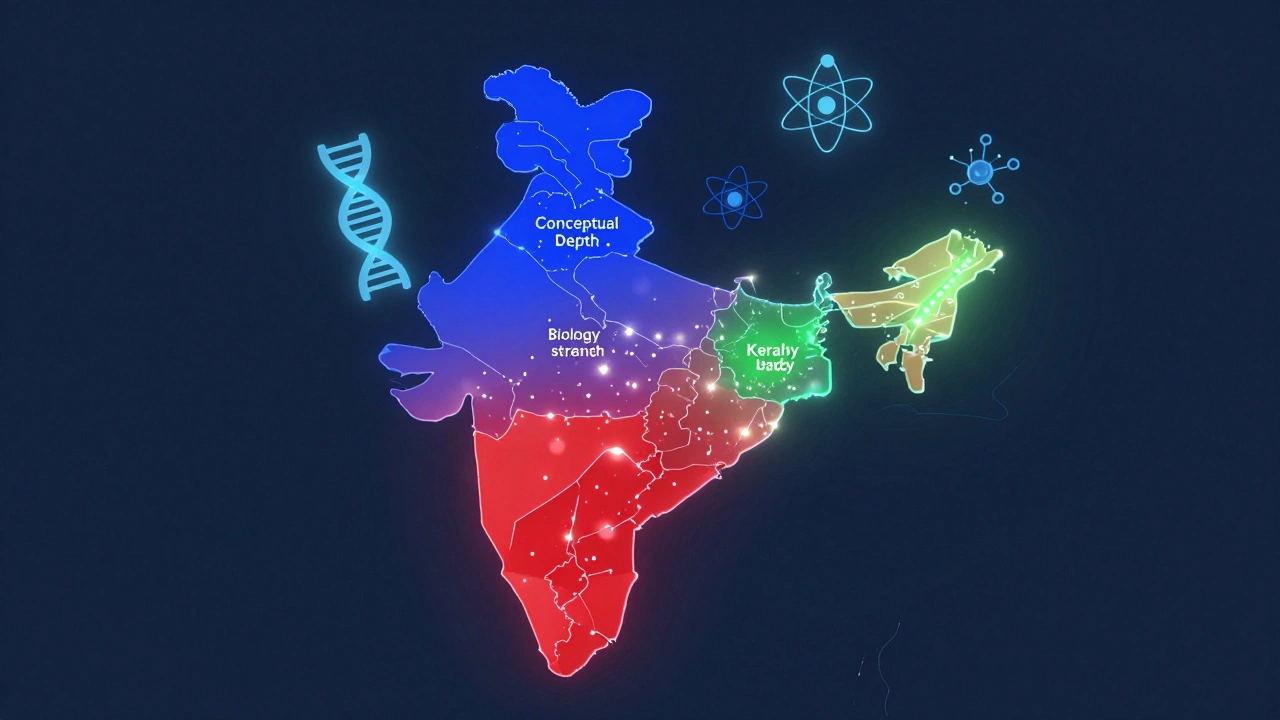
Tamil Nadu leads in elite scorers with over 15,000 students above 700 marks, demonstrating exceptional conceptual depth despite lower total appearances compared to UP.
Every year, as the National Testing Agency (NTA) releases the final NEET is the National Eligibility cum Entrance Test, the single gateway for undergraduate medical admissions in India. scores, a familiar debate erupts across social media and educational forums: Which state actually performs best? Is it the traditional powerhouse of Tamil Nadu, or has Uttar Pradesh overtaken them with sheer volume? The answer isn't just about who gets the most seats; it's about understanding the mechanics of merit, preparation styles, and demographic shifts that define India's medical aspirants.
If you are looking at this from a coaching perspective, the data tells a nuanced story. It’s not merely about raw numbers. It’s about the percentage of students clearing the cutoff versus those who secure a seat in government colleges. This distinction matters because high participation rates don’t always equal high success rates in terms of securing a coveted MBBS or BDS seat.
The Big Three: TN, UP, and Maharashtra
When we analyze the last three years of NEET data (2023, 2024, and early 2025 trends), three states consistently dominate the conversation: Tamil Nadu, a southern Indian state known for its strong public education system and high literacy rates., Uttar Pradesh, the most populous state in India with a massive number of medical aspirants., and Maharashtra, an industrial hub with significant private medical infrastructure..
Tamil Nadu often holds the crown for the highest number of students scoring above 700 marks. In 2024, over 15,000 students from TN crossed this elite threshold. Why? The state’s unique syllabus alignment. Until recently, TN followed a separate board exam pattern that emphasized deep conceptual clarity in Physics, Chemistry, and Biology (PCB). This created a cohort of students who didn’t just memorize facts but understood the underlying principles-a skill that translates well to the tricky, application-based questions in NEET.
However, if you look at the total number of qualified candidates, Uttar Pradesh takes the lead. With millions of aspirants, UP produces the largest pool of successful candidates. But here is the catch: while the absolute number is huge, the *percentage* of students who clear the cutoff relative to those who appear is lower than in smaller states like Kerala or Andhra Pradesh. This suggests that while UP has scale, other states have higher efficiency in their preparation models.
Why Small States Punch Above Their Weight
You might be surprised to see states like Kerala, a southern state with one of the highest literacy rates and healthcare access in India. and Andhra Pradesh, a southern state that merged with Telangana but retains distinct educational trends. ranking highly on a per-capita basis. These states have a cultural emphasis on professional courses, particularly medicine and engineering. In Kerala, the presence of numerous quality government medical colleges creates a competitive environment where students aim for local seats rather than relying solely on national quotas.
Consider the role of regional language coaching. In Andhra Pradesh and Telangana, the rise of Telugu-medium coaching centers has democratized access to quality education. Students who previously struggled with English-heavy materials can now grasp complex biological concepts in their native tongue. This linguistic accessibility has boosted their average scores significantly since 2020.
| State | Total Appearances | Qualified (>113 Marks) | Above 700 Marks | Key Strength |
|---|---|---|---|---|
| Tamil Nadu | ~280,000 | ~95,000 | ~15,200 | Conceptual Depth |
| Uttar Pradesh | ~650,000 | ~210,000 | ~8,500 | Volume & Resilience |
| Maharashtra | ~320,000 | ~110,000 | ~6,800 | Balanced PCB Scores |
| Kerala | ~110,000 | ~65,000 | ~4,100 | High Efficiency Rate |
| Andhra Pradesh | ~250,000 | ~85,000 | ~5,900 | Linguistic Access |
The Coaching Capital Effect: Kota vs. Local Hubs
We cannot talk about state performance without mentioning Kota, a city in Rajasthan famous for its intensive JEE and NEET coaching institutes.. While Rajasthan itself doesn’t always top the list for overall state performance, Kota acts as a magnet for talent from across India. A significant portion of the top 1,000 rankers every year are coached in Kota, regardless of their home state. This skews the perception that "Rajasthan performs well"-in reality, it’s the students *from* other states studying *in* Rajasthan who drive these numbers.
Conversely, states like Delhi and Punjab have benefited from the rise of premium urban coaching centers. New Delhi, being the capital, hosts many top-tier institutes that cater to affluent families who can afford personalized mentorship. This leads to a higher concentration of high scorers in the National Capital Region (NCR), even if the rural parts of neighboring Haryana lag behind in average scores.
Subject-Wise Breakdown: Where Do States Excel?
Performance isn’t uniform across subjects. Here’s how the leading states stack up:
- Biology: Tamil Nadu and Kerala students consistently score highest in Botany and Zoology. Their school curricula place heavy emphasis on NCERT line-by-line memorization, which pays off since 90% of NEET Biology questions are directly from NCERT textbooks.
- Physics: Maharashtra and Karnataka students tend to perform better here. These states have a stronger tradition in engineering entrance preparation (JEE), which overlaps significantly with NEET Physics. The problem-solving approach learned for JEE helps them tackle numerical-heavy Physics questions.
- Chemistry: This is the most balanced subject. However, students from West Bengal show surprising strength in Organic Chemistry, likely due to the rigorous science streams offered in their state boards.
The Impact of Reservation Policies on Seat Allocation
It’s crucial to distinguish between "performing best" in terms of scores and "securing seats." States with robust reservation policies, such as Madhya Pradesh, a central Indian state with significant reserved category quotas in education. and Gujarat, a western Indian state with a mix of public and private medical colleges., see a different distribution of success. While the general category cutoff remains fiercely competitive, students from Scheduled Castes (SC), Scheduled Tribes (ST), and Other Backward Classes (OBC) in these states have higher chances of securing government college seats due to state-specific quotas.
This means that for an aspirant from Madhya Pradesh, "performing well" might mean scoring 550+ to get a seat, whereas a student from Tamil Nadu might need 680+ for the same outcome. This disparity highlights why comparing raw scores across states can be misleading without context.

Emerging Trends: The Rise of Online Hybrid Models
In 2025 and 2026, we are seeing a shift. The dominance of physical coaching hubs is waning slightly as hybrid models gain traction. States like Bihar and Odisha, which previously lagged due to lack of quality infrastructure, are closing the gap. Affordable online platforms combined with local test series have allowed students in tier-2 and tier-3 cities to access the same quality of teaching as those in Kota or Delhi.
This democratization of resources suggests that in the next five years, the performance gap between "top" and "bottom" states will narrow. We may see more consistent high-scorers emerging from regions that were previously underrepresented, simply because the barrier to entry for quality coaching has lowered.
What Does This Mean for You?
If you are an aspirant, your state’s historical performance shouldn’t dictate your confidence. Instead, use it as a benchmark. If you’re from a high-performing state like Tamil Nadu, know that you face intense competition locally. If you’re from a developing region, leverage the available online resources to bridge the gap.
Focus on mastering NCERT Biology, practicing previous years’ questions (PYQs), and taking regular mock tests. The data shows that consistency beats intensity. Students who study steadily for two years outperform those who cram in six months, regardless of which state they hail from.
Which state has the highest number of NEET qualifiers?
Uttar Pradesh typically has the highest absolute number of NEET qualifiers due to its large population and high number of aspirants. However, when adjusted for population size, states like Tamil Nadu and Kerala often have higher qualification rates.
Is it easier to get a medical seat in some states than others?
Yes, ease of admission varies based on the ratio of government medical seats to applicants. States with more government colleges per capita, like Kerala and Tamil Nadu, may offer relatively better opportunities for high-scoring students compared to states with fewer seats and high demand.
Do students from coastal states perform better in NEET?
Coastal states like Kerala, Karnataka, and Tamil Nadu often show strong performance due to established educational ecosystems and early exposure to competitive exam preparation. However, inland states like Maharashtra and Delhi-NCR also produce top rankers through robust coaching infrastructures.
How does the medium of instruction affect NEET scores?
While NEET is conducted in multiple languages, English-medium students historically had an advantage in understanding complex questions. However, with improved translation and regional coaching, this gap is narrowing. Mastery of concepts matters more than the language of learning.
Which state produces the most top 100 rankers in NEET?
Tamil Nadu and Maharashtra frequently contribute the highest number of students to the top 100 ranks. This is attributed to their focus on conceptual clarity and the presence of high-quality coaching centers in major cities like Chennai and Mumbai.