Education Destination Finder
What is your primary goal for your child's education? Select the priority that best matches your vision to see the recommended state.
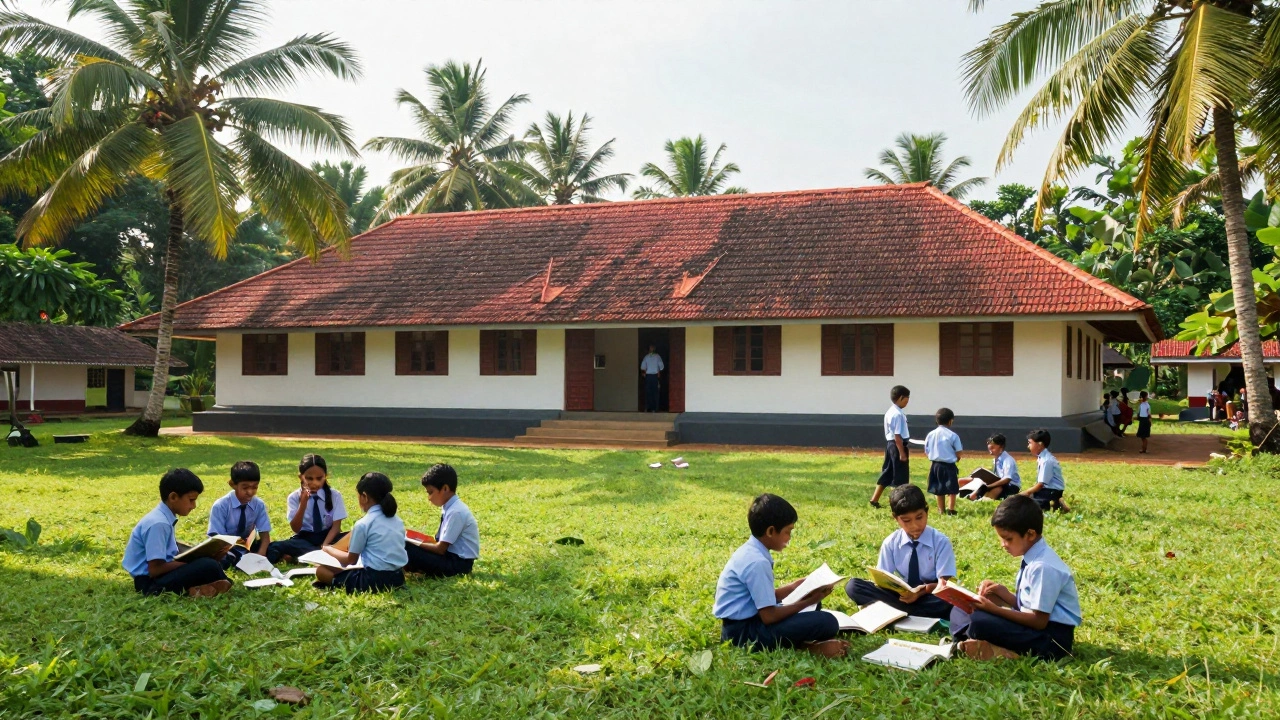
Universal Literacy & Access
Strong public schooling and high baseline literacy.
Tech & Innovation
Focus on coding, robotics, and future-proof skills.
Competitive Exam Prep
Intense academic discipline for IIT/NEET paths.
Corporate & Arts
Networking, diverse opportunities, and urban exposure.
Why this fits:
The Literacy Leader: Why Kerala Wins on Basics
If we define "best education" by how many people can read and write, Kerala is the undisputed champion. The state has historically invested in a massive network of government schools that reach the smallest villages. For a parent, this means that even in rural areas, the baseline quality of teaching is surprisingly high. But there's a catch. While the state excels at the foundation, some argue that the system can be too focused on rote learning. If you're looking for a school that follows the CBSE syllabus (Central Board of Secondary Education), you'll find plenty of private options here, but the government-run schools often follow the state board. The transition from a state board to a national competitive exam like JEE can sometimes feel like a leap because the pacing differs.The Tech and Innovation Hub: Karnataka and Tamil Nadu
Now, let's talk about the "future-proof" education. If you want your kids around a culture of innovation, Karnataka and Tamil Nadu are where the action is. In cities like Bangalore and Chennai, schools are more likely to integrate coding, robotics, and entrepreneurship into the curriculum. Karnataka, in particular, has a massive concentration of high-end private schools that lean heavily on the CBSE and ICSE boards. Why does this matter? Because these boards are standardized across India. If you move from Bangalore to Delhi, your child doesn't miss a beat. These states also have the best proximity to top-tier universities, which creates a "trickle-down" effect where school teachers are more attuned to what the higher-education market demands.| State | Primary Strength | Preferred Board | Key Outcome |
|---|---|---|---|
| Kerala | Literacy & Access | State Board / CBSE | Highest Baseline Literacy |
| Karnataka | Tech & Innovation | CBSE / ICSE | Strong STEM Pipeline |
| Tamil Nadu | Academic Rigor | State Board / CBSE | High Competitive Exam Scores |
| Maharashtra | Diverse Opportunities | CBSE / SSC | Corporate & Arts Exposure |
The Competitive Edge: Tamil Nadu's Academic Rigor
If you've ever wondered why so many students from the South dominate the IIT (Indian Institutes of Technology) entrance exams, look at Tamil Nadu. The culture here treats education like a professional sport. There is an intense focus on mathematics and science, and the coaching culture is deeply embedded in the school system. Tamil Nadu schools often push students harder than those in the North. While this can lead to stress, it results in students who are incredibly disciplined and technically proficient. For a family prioritizing a path toward medicine or engineering, the academic ecosystem here provides a massive advantage. The schools don't just teach the syllabus; they teach how to crack the test.Navigating the Board Systems: CBSE vs. State Boards
Choosing a state is only half the battle; you also have to choose the board. Most parents moving between states gravitate toward the CBSE because it's the most versatile.Think of the CBSE syllabus as the "universal language" of Indian schooling. It's designed by the central government to be consistent. Whether you are in a fancy school in Maharashtra or a modest one in Punjab, the textbooks are the same. This is a lifesaver for military families or corporate employees who relocate every three years.
On the flip side, State Boards are often more reflective of local culture and language. In Kerala, the state board is excellent for linguistic pride and local history. But if the goal is to clear the NEET (National Eligibility cum Entrance Test) for medical school, the CBSE syllabus is almost always the better bet because its content aligns more closely with the national exam patterns.The Urban Powerhouses: Maharashtra and Delhi
We can't ignore the big cities. Maharashtra, specifically Mumbai and Pune, offers a different kind of "best." Here, education is about networking and exposure. Students have access to the best museums, corporate internships, and a diverse array of international schools. If your child is leaning toward business, media, or the arts, Maharashtra is arguably the best place to be. Delhi is the other heavyweight. Because it's the capital, it has some of the most prestigious schools in the country. The competition in Delhi is fierce, and the schools are well-funded. However, the air quality and urban congestion can be a trade-off. In Delhi, you'll find a higher density of "super-schools"-institutions that offer world-class facilities, Olympic-sized pools, and international exchange programs-but the cost of entry is significantly higher than in the Southern states.Common Pitfalls When Choosing a State for Schooling
It's easy to look at a literacy percentage and think a state is "perfect." But a high literacy rate doesn't always mean high-quality secondary education. Here are a few things to watch out for:- The Coaching Trap: In states like Rajasthan or Haryana, you'll find "coaching hubs" (like Kota). While these are great for test prep, the actual school environment can sometimes become secondary to the coaching center. This can lead to burnout.
- The Language Gap: If you move to a state with a very strong local board (like West Bengal), ensure your child is in a CBSE or ICSE school if you plan to move again. Switching from a regional board to a national one in Grade 11 is a nightmare.
- Infrastructure vs. Outcomes: A school with a fancy glass building doesn't guarantee better learning. Look at the teacher-to-student ratio and the average board results of the school over the last five years.
The Verdict: Which One Should You Pick?
There is no single "best" state because education goals differ. If you want a safe, inclusive environment where basic literacy is guaranteed for everyone, Kerala is your winner. If you want a high-tech, future-forward environment with a strong lean toward the STEM (Science, Technology, Engineering, and Mathematics) fields, Karnataka is the spot. For those who want raw academic competition and the best chance at cracking the hardest exams in the country, Tamil Nadu is the place to be. And for those seeking corporate exposure, arts, and diverse networking, Maharashtra's urban centers can't be beaten.Is CBSE better than State Boards?
For most people, yes. CBSE is standardized across India, making it easier to move between states. It also aligns better with national competitive exams like JEE and NEET. State boards are great for local cultural knowledge but can be harder to transition from if you relocate.
Which state has the highest literacy rate in India?
Kerala consistently holds the highest literacy rate in India, often cited above 94%. This is due to the state's long-term investment in public schooling and community-led education initiatives.
Are private schools in Bangalore better than government schools in Kerala?
It depends on the goal. Bangalore's private schools offer better tech integration and a path toward corporate careers. Kerala's government schools provide a stronger, more equitable foundation for a broader range of the population. One focuses on "elite' outcomes, the other on "universal" access.
Does the state influence the quality of CBSE education?
While the syllabus is the same, the *delivery* changes. A CBSE school in Tamil Nadu might emphasize rigorous math drills, while one in Maharashtra might focus more on extracurriculars and projects. The local culture of the state always leaks into the classroom.
Which state is best for medical and engineering prep?
Tamil Nadu and Karnataka are generally considered the best due to their high concentration of coaching centers, a culture of academic rigor, and proximity to some of the country's best technical institutes.