English Fluency Path Estimator
Personalized Learning Plan
Estimated Time to Conversational Fluency:
Enter your details and click calculate to see your personalized fluency timeline.
- Immersion is the fastest route to fluency.
- Focus on high-frequency vocabulary first.
- Consistency beats intensity; 30 minutes daily is better than 5 hours once a week.
- Speaking and listening must happen simultaneously with reading and writing.
The Immersion Shortcut
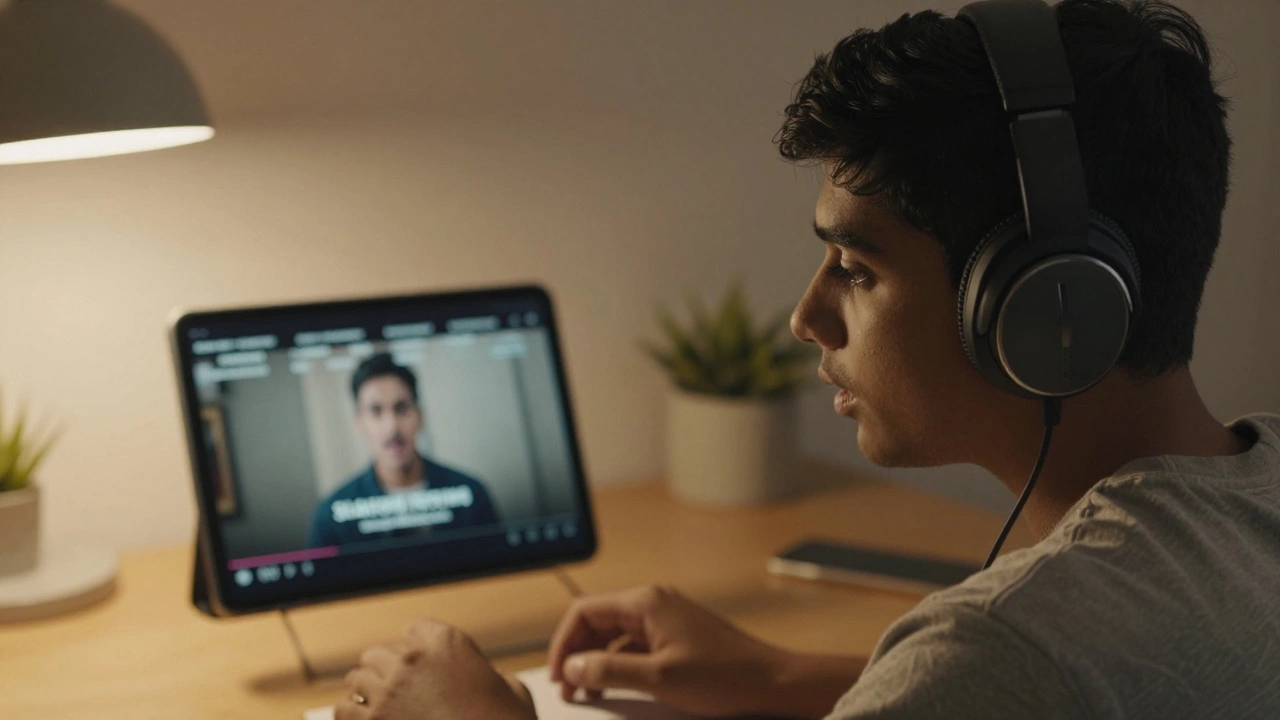
You don't need a plane ticket to London or New York to immerse yourself. Immersion is the process of surrounding yourself with the target language until it becomes your primary means of communication . If you are sitting in your room in Brazil or Japan, you can create an "artificial immersion environment." This means changing your phone settings to English, watching Netflix without subtitles (or with English subtitles), and listening to English podcasts during your commute.
Why does this work? Your brain is a pattern-recognition machine. When you are forced to deal with English in real-world contexts, your brain stops translating from your native tongue and starts thinking in English. If you only study grammar rules, you are learning about the language, not the language itself. To speed this up, try "shadowing." This is where you listen to a native speaker and repeat exactly what they say, mirroring their rhythm and intonation, just a split second after they say it.
Focus on High-Frequency Words
If you open a dictionary, you'll find thousands of words you will never use. Learning "obsolete" or rare vocabulary is a huge time-sink. Instead, focus on the Pareto Principle, which suggests that 20% of the effort produces 80% of the results . In English, a small set of words makes up the vast majority of daily conversation.
Research shows that knowing the 1,000 most common English words allows you to understand about 75% of all spoken communication. If you push that to 3,000 words, you can handle almost any everyday situation. Don't waste time on academic jargon if your goal is to have a conversation at a pub or a business meeting. Start with functional phrases-things like "Could you help me with..." or "I'm not sure if..."-rather than memorizing lists of animals or colors.
| Method | Speed of Fluency | Effort Level | Best For |
|---|---|---|---|
| Traditional Classroom | Slow | Medium | Grammar foundations |
| Self-Study Apps | Medium | Low | Vocabulary building |
| Full Immersion | Very Fast | High | Conversational fluency |
| 1-on-1 Tutoring | Fast | Medium | Correcting bad habits |
Choosing the Right English Speaking Courses
Not all English speaking courses are created equal. Many courses focus on "passive learning," where you watch a video and answer a multiple-choice question. This is a trap. To learn fast, you need "active production." Look for courses that prioritize Communicative Language Teaching (CLT), an approach that emphasizes interaction as both the means and the ultimate goal of study .
A great course should force you to speak for at least 50% of the lesson time. If the teacher spends the whole hour explaining the present perfect tense, you are wasting your money. You need a environment where you are forced to negotiate meaning, describe things you don't know the word for, and handle the stress of a real conversation. If you are looking at online options, check if they offer live conversation practice rather than just pre-recorded modules.

The Power of a Speaking Partner
You cannot learn to swim by reading a book about water; you have to get wet. Similarly, you cannot learn to speak English without speaking. This is where Language Exchange, a practice where two people speak their respective native languages to help each other learn , becomes invaluable. Using platforms like Tandem or HelloTalk allows you to find partners who are eager to help you in exchange for learning your language.
The key here is to avoid the "translation loop." When you struggle to find a word, don't reach for a translator immediately. Instead, try to describe the object or concept using words you already know. If you forget the word for "refrigerator," say "the cold box in the kitchen." This mental exercise builds the neural pathways necessary for fluency. It teaches your brain how to navigate around gaps in your knowledge, which is exactly what native speakers do when they forget a word.
Overcoming the Fear of Mistakes
The biggest barrier to fast learning isn't a lack of talent; it's the fear of looking stupid. Many learners wait until their grammar is "perfect" before they start speaking. This is a fundamental mistake. Grammar is polished through usage, not through avoidance.
Think of it like a child learning to walk. They don't study the physics of balance; they fall down a hundred times and eventually get it right. When you make a mistake in English and someone corrects you, that correction sticks much better than a rule you read in a book. The fastest learners are those who treat every mistake as a data point. If you can embrace the awkwardness of a mispronounced word or a wrong tense, you will accelerate your progress exponentially.

Integrating English Into Your Daily Routine
If you have a busy schedule, don't try to carve out three hours for "study time." Instead, weave English into the things you already do. This is called Micro-learning, the practice of learning in short, focused bursts throughout the day . For example, while you are brushing your teeth, describe your plans for the day out loud in English. While you are cooking, read the recipe in English.
Use a Spaced Repetition System (SRS), a technique for efficiently remembering information by reviewing it at increasing intervals , using apps like Anki. Instead of cramming 50 words on Sunday, review 10 words every morning. This prevents the "forgetting curve" and ensures that vocabulary moves from your short-term memory to your long-term memory. When you combine this with active speaking, the words stop being "things you know" and become "things you use."
Can I really become fluent in 3 months?
It depends on your definition of "fluent." You won't sound like a Shakespearean actor, but you can definitely reach a conversational level where you can handle most daily interactions. This requires about 4-6 hours of active engagement per day-mixing listening, speaking, and SRS vocabulary work. If you only study an hour a week, it will take years.
Should I focus on grammar first or speaking first?
Speaking first. Focus on communication over perfection. If you can get your point across, you are winning. You can pick up the grammar naturally through reading and listening, and then use a tutor or a course to refine the technical details. Learning grammar in isolation often leads to "analysis paralysis," where you are too afraid to speak because you're thinking about the rules.
Which is better: a group class or a private tutor?
For speed, a private tutor wins every time. In a group of 10 people, you might only speak for 5 minutes per lesson. With a private tutor, you are speaking for the entire hour. However, group classes are great for practicing social dynamics and hearing the common mistakes other students make, which can actually help you understand the language better.
Do I need to live in an English-speaking country to be fluent?
No. While living abroad helps, it's not a requirement. Many people live in English-speaking countries for years and never learn the language because they stick to their own community. The key is the *amount* of English you engage with. If you create an immersion environment at home through media and conversation partners, you can achieve the same results.
Are free apps enough to learn English?
Apps are great for vocabulary and basic structure, but they cannot make you fluent. Fluency requires real-time interaction and the ability to react to unexpected responses. Apps are a supplement, not a solution. Use them to build a base, then move to speaking with real humans as quickly as possible.
Next Steps for Different Learners
If you are a complete beginner, don't jump straight into a conversation. Start with the top 500 high-frequency words and a basic English speaking course to understand how sentences are built. Once you can form simple "Subject-Verb-Object" sentences, find a patient language exchange partner.
If you are an intermediate learner who feels "stuck," you likely have a gap in your listening skills. Stop using subtitles in your native language. Switch to English subtitles, and then eventually to none at all. Start recording yourself speaking and compare it to a native speaker to identify specific pronunciation issues.
For advanced learners looking to polish their English for business, stop using general materials. Start reading industry-specific journals and listening to professional podcasts in your field. Your goal is no longer just "fluency," but "precision." Focus on nuance, idioms, and the cultural context of how a professional conversation is structured in an English-speaking environment.