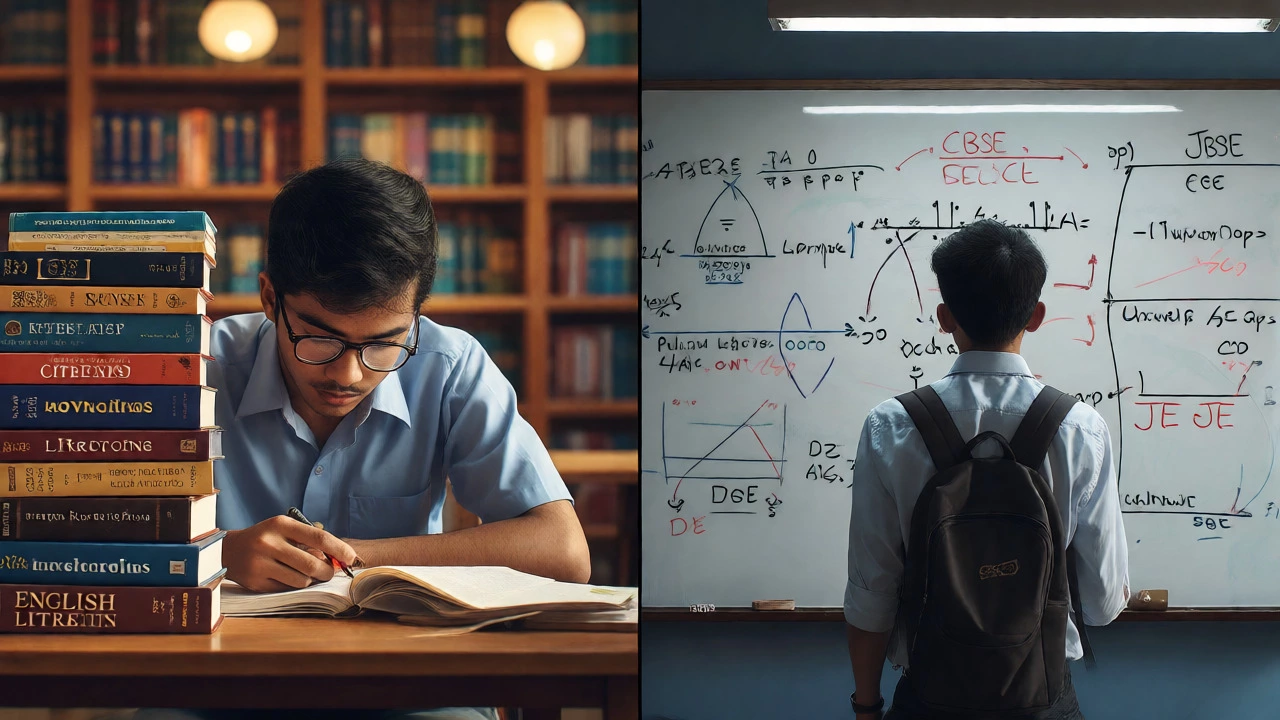
CBSE vs ICSE Fit Finder
Key Insight from Article:
Ask any Indian student which board is harder, and you'll get a passionate debate. Some swear by ICSE being a beast because of its vast syllabus, while others argue that CBSE is tougher due to its unpredictable question patterns and intense competition. The truth? Neither board is universally "the toughest." It depends entirely on your learning style, career goals, and how you handle pressure. But if we look at data, student feedback, and curriculum structure, we can identify where each board challenges students the most.
The confusion often stems from comparing apples to oranges. CBSE, or the Central Board of Secondary Education, focuses on standardized national exams like JEE and NEET. In contrast, CISCE (which runs ICSE) emphasizes holistic education with a heavier weight on English literature and practical applications. When people ask about the "2 toughest" boards, they usually mean the two most prominent ones: CBSE and ICSE. State boards are often considered easier in terms of rote learning, but let's be honest-state board standards vary wildly across states like Bihar versus Tamil Nadu. So, for this discussion, we're focusing on the big two national-level contenders.
Why Students Think ICSE Is Harder
If you talk to an ICSE student, they'll tell you the syllabus is endless. And they're right. The ICSE syllabus is significantly broader than CBSE's. For example, in Science subjects, ICSE requires deeper theoretical understanding and more extensive practical work. You aren't just memorizing formulas; you're expected to apply concepts in novel situations. This makes the preparation phase much longer and mentally draining.
Another major factor is the language component. ICSE places a heavy emphasis on English Literature. You have to read full-length novels, poetry collections, and plays. Writing skills are scrutinized rigorously. If you struggle with essay writing or literary analysis, ICSE will feel like climbing Everest without oxygen. CBSE, on the other hand, treats English as a functional subject. The focus is on grammar, comprehension, and basic creative writing. For many students who prefer logic over prose, this difference alone makes ICSE seem infinitely tougher.
| Feature | CBSE | ICSE |
|---|---|---|
| Syllabus Breadth | Narrower, focused on core concepts | Broad, covers diverse topics |
| English Focus | Functional grammar and comprehension | Literature, critical analysis, creative writing |
| Question Pattern | Predictable, NCERT-based | Unpredictable, application-heavy |
| Internal Assessment | Less weighted in final score | Highly weighted, continuous evaluation |
| Competition Level | Extremely high (JEE/NEET focus) | Moderate (diverse career paths) |
The Hidden Difficulty of CBSE
So, if ICSE has a bigger syllabus, why do so many CBSE students say their board is tougher? Here's the twist: CBSE difficulty isn't about volume; it's about precision and competition. The CBSE curriculum is tightly aligned with competitive exams like JEE Main and NEET UG. This means every topic taught in Class 11 and 12 is fair game for these entrance tests. The pressure isn't just passing your board exams; it's securing a top rank among millions of aspirants.
Furthermore, CBSE questions can be tricky. While the pattern is generally predictable, recent years have seen a shift toward competency-based questions. These aren't straightforward "define X" questions. They require you to analyze case studies, interpret graphs, and solve multi-step problems under time constraints. If you rely solely on rote memorization, you'll hit a wall. You need conceptual clarity, which takes genuine effort to develop. Plus, the grading curve in CBSE can be unforgiving. A small mistake in calculation or a missed step can cost you significant marks, unlike some state boards where partial credit is more generous.
Let's not forget the social aspect. CBSE schools are everywhere. From tier-1 cities to small towns, the sheer number of students creates a massive peer pressure environment. Seeing classmates ace mock tests can trigger anxiety that affects performance. ICSE students, while stressed by their workload, often face less direct comparison because the cohort sizes in ICSE-affiliated schools are typically smaller and more elite.
Subject-Specific Challenges
To truly understand which board hits hardest, we need to look at specific subjects. In Mathematics, both boards demand high proficiency. However, CBSE math problems often mirror JEE-style complexity earlier in the schooling years. ICSE math is rigorous but tends to stay within the scope of the textbook examples more closely. If you love solving abstract puzzles, CBSE might actually feel more rewarding despite being harder.
In Science, specifically Physics and Chemistry, ICSE provides a deeper dive into theory. You'll encounter more detailed derivations and complex chemical mechanisms. CBSE sticks to NCERT textbooks, which are concise. Paradoxically, this makes CBSE harder for students who want to go beyond the book for competitive exams, because they have to self-study advanced material outside the prescribed syllabus. ICSE gives you that depth upfront, saving you time later but making the daily grind heavier.
History and Political Science are another battleground. ICSE includes more global history and detailed constitutional analysis. CBSE focuses heavily on Indian history and contemporary politics. If you enjoy storytelling and global context, ICSE wins. If you prefer focused, exam-oriented facts about your own country, CBSE is more manageable.

How to Decide Which Path Fits You
Choosing between these boards isn't just about picking the "easier" one. It's about aligning with your strengths. Are you a strong reader and writer? Do you enjoy discussing literature and analyzing texts? Then ICSE will leverage your natural talents, even if the workload is heavy. On the flip side, if you're a logical thinker who prefers clear-cut answers and wants to prepare for engineering or medical entrance exams seamlessly, CBSE is your best bet.
Consider your mental resilience too. ICSE demands consistency throughout the year. Internal assessments account for 20% of your final grade, meaning slacking off in Class 9 or 10 hurts you in Class 10 finals. CBSE allows for more last-minute cramming because the external exam carries more weight. If you thrive under deadline pressure, CBSE suits you. If you panic when everything falls on you at once, ICSE's distributed assessment model might save your sanity.
Also, think about your future college plans. Top universities in India accept both, but international colleges often view ICSE's comprehensive profile favorably due to its emphasis on soft skills and English proficiency. Conversely, Indian engineering colleges respect the CBSE foundation because it mirrors their first-year curriculum.
Tips to Survive Either Board
No matter which board you choose, here are three rules to survive the grind:
- Master the Basics Early: Don't wait until Class 10 or 12 to start serious studying. Build strong foundations in Class 8 and 9. Concepts compound over time.
- Practice Past Papers: This is non-negotiable. For CBSE, stick to the last 5 years' papers to spot trends. For ICSE, go back 10 years because their patterns change less drastically but cover wider ground.
- Manage Your Health: Both boards cause burnout. Sleep, exercise, and hobbies aren't luxuries-they're necessities. A tired brain retains less information, no matter how hard you study.
Ultimately, calling one board "the toughest" is subjective. ICSE is tougher on time management and breadth of knowledge. CBSE is tougher on precision, speed, and competitive pressure. The real enemy isn't the board; it's poor planning and lack of support. With the right strategy, either board becomes manageable. Stop worrying about which label sounds scarier and start focusing on what works for your brain.
Is ICSE really harder than CBSE?
Generally, yes, in terms of syllabus volume and language requirements. ICSE covers more ground and demands higher proficiency in English literature. However, CBSE can be harder for students aiming for competitive exams like JEE/NEET due to its alignment with those tests and intense competition.
Which board is better for NEET preparation?
CBSE is widely considered better for NEET preparation because its syllabus closely matches the NEET UG curriculum. Most coaching institutes also design their courses around CBSE guidelines, making it easier for CBSE students to integrate board prep with entrance exam prep.
Do international universities prefer ICSE or CBSE?
International universities often view ICSE favorably because of its rigorous English component and holistic assessment methods. However, CBSE is globally recognized as well. The deciding factor is usually your grades and extracurriculars rather than the board itself.
Can I switch from CBSE to ICSE in Class 11?
Yes, you can switch, but it's challenging. The ICSE Class 11 syllabus assumes prior exposure to ICSE Class 9 and 10 content, particularly in English and Sciences. You may need extra tutoring to bridge the gap, especially in literature and practical science components.
Are state boards easier than CBSE and ICSE?
In most cases, yes. State boards often have shorter syllabi and less rigorous evaluation standards compared to CBSE and ICSE. However, quality varies significantly by state. Boards in states like Kerala or Maharashtra can be quite demanding, while others may be more lenient.