
IIT JEE Preparation Timeline Estimator
Key Metrics
Recommended Daily Split
- New Concept Learning --
- Problem Solving --
- Revision & Mock Analysis --
- Breaks & Rest --
Phase-Wise Roadmap
| Phase | Duration | Focus Area | Goal |
|---|
You’ve decided to aim for the IIT JEE is India’s most competitive engineering entrance examination conducted by the National Testing Agency (NTA). It serves as the gateway to the prestigious Indian Institutes of Technology (IITs), which are globally recognized for their rigorous academic standards and high placement rates.. Now comes the big question: how much time do you actually need? The short answer is that it depends on your starting point. The long answer involves understanding the sheer volume of the syllabus, the depth of conceptual clarity required, and the strategic allocation of hours per day.
If you’re a Class 11 student just starting out, you have roughly two years. If you’re in Class 12, you’re looking at about one year or less. And if you’re a dropper-someone taking a gap year to retake the exam-you might be dedicating twelve to fourteen months exclusively to this goal. But counting months isn’t enough. You need to count focused hours. Let’s break down exactly what that timeline looks like and how to manage it without burning out.
The Baseline: Understanding the Scope of IIT JEE
Before you can estimate time, you must understand the workload. The JEE Syllabus consists of three core subjects: Physics, Chemistry, and Mathematics. Each subject covers topics from Classes 11 and 12, but the difficulty level goes far beyond standard school textbooks. For instance, while school physics might ask you to apply a formula, JEE Physics often requires you to derive that formula under time pressure or apply it to a novel, multi-concept scenario.
Consider the scale:
- Physics: Mechanics, Electrodynamics, Optics, Modern Physics. Mechanics alone can take 3-4 months of dedicated practice.
- Chemistry: Physical, Organic, and Inorganic. This subject demands both calculation speed and rote memorization of reactions and periodic trends.
- Mathematics: Algebra, Calculus, Coordinate Geometry, Trigonometry. Calculus and Algebra form the backbone and require significant problem-solving hours.
The total number of problems a successful candidate typically solves ranges from 5,000 to 10,000 quality questions. That’s not just reading solutions; it’s active struggle with each problem. If you solve one complex problem every hour (including review), that’s 5,000 to 10,000 hours of pure practice. Spread over two years, that’s manageable. Compressed into six months, it becomes grueling.
Scenario 1: The Two-Year Plan (Class 11 & 12)
This is the ideal scenario. You start fresh in Class 11 with no prior backlog. Here, consistency beats intensity. You don’t need to study 12 hours a day. Instead, aim for 6-8 hours of focused study alongside your school commitments.
Phase 1: Class 11 Foundation (Months 1-12)
In Class 11, your goal is conceptual clarity. Don’t rush through chapters. Spend 2-3 weeks on major topics like Kinematics or Rotational Motion. Use standard reference books rather than just coaching modules. Build strong notes during this phase because these notes will become your primary revision tool in Class 12.
Phase 2: Class 12 Integration (Months 13-18)
As you enter Class 12, you’ll face new topics like Electrostatics or Integral Calculus. Simultaneously, you must keep revising Class 11 material. Allocate 60% of your time to current Class 12 topics and 40% to revising Class 11. This prevents the common mistake where students forget half their syllabus by the time they reach the end of Class 12.
Phase 3: Final Revision & Mock Tests (Months 19-24) In the last six months before JEE Main and Advanced, shift entirely to revision and test-taking. Take full-length mock tests weekly. Analyze every mistake. This phase is about speed, accuracy, and exam temperament.
Scenario 2: The One-Year Sprint (Class 12 Only)
If you missed Class 11 preparation or joined late, you’re now in a race against time. You have roughly 10-12 months until JEE Main and another 6 months until JEE Advanced. This requires a more aggressive approach: 10-12 hours of study daily.
Your strategy must change from “learning everything” to “mastering high-weightage topics.” Not all chapters carry equal marks. Focus heavily on:
- Physics: Mechanics, Electrodynamics, Thermodynamics.
- Chemistry: Physical Chemistry calculations, Organic reaction mechanisms, Inorganic NCERT lines.
- Math: Calculus, Algebra, Vectors & 3D Geometry.
Skip overly niche or low-yield topics if you’re running behind. Prioritize breadth first, then depth. Use online resources and video lectures to grasp concepts faster than traditional classroom pacing allows. Remember, in a one-year plan, consistency is non-negotiable. Missing even ten days can derail your momentum.

Scenario 3: The Dropper Year (Gap Year)
Droppers have a unique advantage: zero distractions. No school, no college applications, no part-time jobs. Just you and the syllabus. However, the psychological pressure is immense. Most droppers study 12-14 hours a day.
Your timeline should look like this:
- Months 1-4: Complete the entire syllabus once. Focus on understanding, not speed.
- Months 5-8: Second pass. Solve advanced problems. Identify weak areas.
- Months 9-12: Intensive mock tests. Simulate exam conditions strictly. Work on time management and elimination strategies.
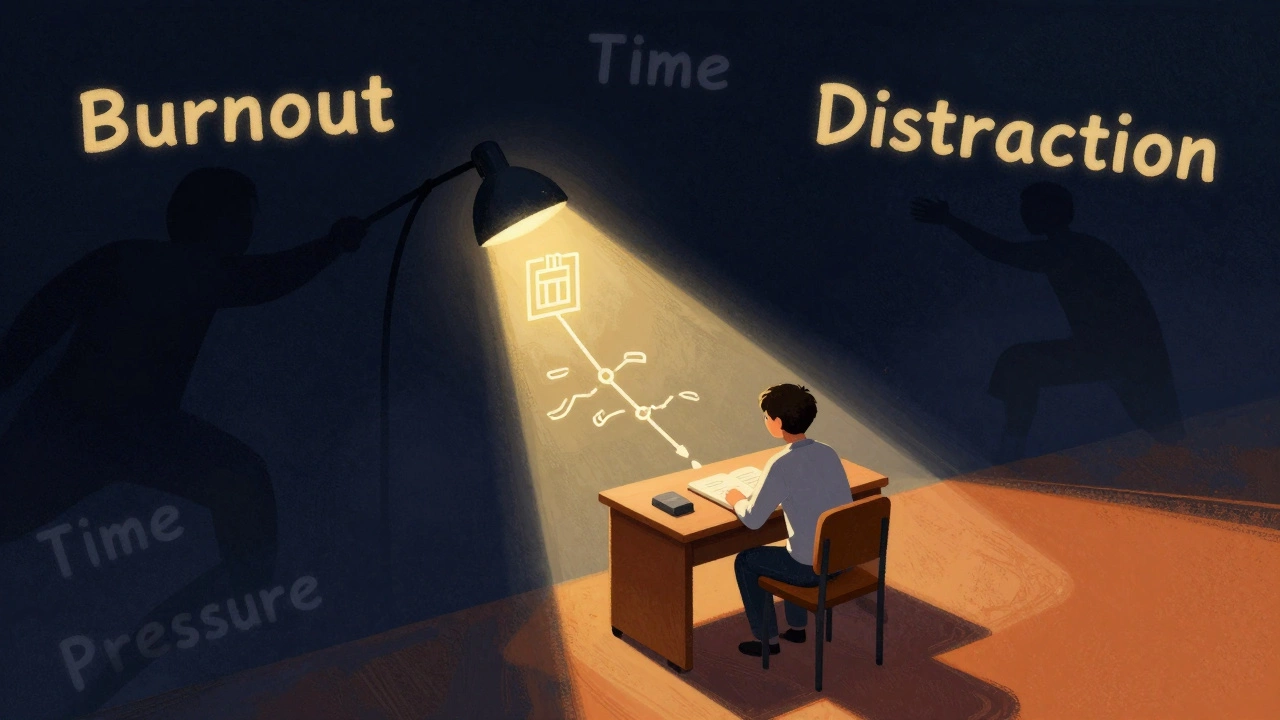
The danger for droppers is burnout. Without external structure, it’s easy to lose discipline. Create a rigid routine. Wake up at the same time, study in blocks, and take regular breaks. Treat preparation like a full-time job with fixed hours.
Daily Routine: Quality Over Quantity
It’s tempting to brag about studying 15 hours a day. But if 5 of those hours are spent scrolling phones or staring blankly at a book, it’s useless. Effective study time is measured in focused intervals.
Use the Pomodoro technique or similar methods: 50 minutes of intense focus followed by a 10-minute break. During those 50 minutes, no phone, no social media, no distractions. Aim for 8-10 hours of *effective* study time daily. Here’s a sample breakdown:
| Time Slot | Activity | Focus Area |
|---|---|---|
| 6:00 AM - 9:00 AM | Deep Work Session 1 | New Concept Learning (Math/Physics) |
| 9:00 AM - 9:30 AM | Break & Breakfast | Mental Reset |
| 9:30 AM - 12:30 PM | Deep Work Session 2 | Problem Solving (Chemistry/Math) |
| 12:30 PM - 2:00 PM | Lunch & Nap | Physical Rest |
| 2:00 PM - 5:00 PM | Deep Work Session 3 | Revision & Weak Topics |
| 5:00 PM - 6:00 PM | Exercise/Walk | Physical Health |
| 6:00 PM - 8:00 PM | Mock Test / Analysis | Exam Simulation |
| 8:00 PM - 9:00 PM | Light Review | Notes & Formulas |
Notice the inclusion of exercise and naps. Your brain consolidates learning during rest. Skipping sleep to study more is counterproductive. It reduces retention and increases errors.
The Role of Resources and Coaching
Do you need coaching? Not necessarily. Many top rankers are self-studied. However, coaching provides structure, peer competition, and access to curated materials. If you join a coaching institute, ensure it aligns with your pace. If you’re self-studying, you must be disciplined enough to create your own roadmap.
Key resources include:
- NCERT Textbooks: Essential for Chemistry, especially Inorganic and Organic basics.
- Standard Reference Books: HC Verma for Physics, RD Sharma for Math, OP Tandon for Chemistry.
- Previous Year Questions (PYQs): The most important resource. Solve at least 10 years of JEE Main and Advanced papers.
- Online Platforms: For doubt resolution and additional practice sets.
Don’t hoard books. Pick one good source per topic and master it. Switching between multiple books leads to confusion and wasted time.
Avoiding Common Pitfalls
Even with the right timeline, many students fail due to poor strategy. Here are the biggest traps:
1. Ignoring Weak Subjects
Many students love Math but hate Chemistry. They spend 80% of their time on Math. This is fatal. JEE rewards balanced performance. Improve your weakest subject early. It’s easier to raise a score from 50 to 70 than from 90 to 95.
2. Neglecting Revision
Learning a concept once doesn’t mean you’ll remember it six months later. Spaced repetition is key. Revise topics after 1 day, 1 week, 1 month, and 3 months. Create concise formula sheets and reaction charts for quick reviews.
3. Taking Too Few Mock Tests
Reading theory feels productive, but it’s passive. Mock tests are active. They expose gaps in knowledge, improve speed, and build stamina. Start taking sectionals in Month 3 and full mocks in Month 6. Analyze each test thoroughly. Why did you make a mistake? Was it a conceptual error, calculation slip, or time pressure?
4. Burnout and Mental Health
JEE preparation is a marathon, not a sprint. Anxiety, depression, and exhaustion are common. Talk to friends, family, or counselors. Maintain hobbies outside of studies. A healthy mind performs better than an exhausted one.
Final Thoughts: It’s About Smart Work
So, how much time is required? If you start in Class 11, two years of consistent 6-8 hour days. If you start in Class 12, one year of intense 10-12 hour days. If you’re a dropper, one year of structured 12-14 hour days. But remember, time is only one variable. Efficiency matters more.
Track your progress weekly. Are you solving problems faster? Are your mock scores improving? Adjust your plan accordingly. Stay flexible. Listen to your body and mind. And above all, stay focused on the process, not just the result. The IIT JEE is tough, but with the right timeline and strategy, it’s absolutely achievable.
Can I crack JEE in 6 months?
Cracking JEE in 6 months is extremely challenging but possible if you have a strong foundation from Class 11 and 12 school exams. You would need to study 12-14 hours daily, focusing only on high-weightage topics and previous year questions. It requires exceptional discipline and mental resilience. For most students, a 12-month timeline is more realistic and sustainable.
How many hours should I study daily for JEE?
For Class 11 students, 6-8 hours of focused study is sufficient. For Class 12 students, aim for 8-10 hours. Droppers should target 12-14 hours. The key is quality over quantity. Ensure these hours are distraction-free and involve active problem-solving rather than passive reading.
Is NCERT enough for JEE preparation?
NCERT is essential, particularly for Chemistry (Inorganic and Organic) and basic Physics concepts. However, it is not sufficient for JEE Advanced. You need standard reference books like HC Verma for Physics and RD Sharma for Mathematics to tackle the higher difficulty level of the exam. Use NCERT as your base and reference books for depth.
When should I start preparing for JEE?
The ideal time to start is when you enter Class 11. This gives you two full years to cover the syllabus, revise, and practice. Starting in Class 12 is also common but requires a more intensive schedule. Starting earlier allows for a deeper understanding of concepts and reduces last-minute stress.
What is the difference between JEE Main and JEE Advanced preparation?
JEE Main focuses on speed, accuracy, and broad coverage of the syllabus. JEE Advanced tests deep conceptual understanding, multi-concept problems, and analytical skills. Preparation for Main involves solving a wide variety of problems quickly. Preparation for Advanced requires tackling complex, unconventional problems that demand creative thinking. You must qualify Main to appear for Advanced.