
NEET Resource Strategy Generator
Your Current Status
Select how thoroughly you have completed the core resources.
Recommended Action Plan
Waiting for input...
Every year, thousands of students walk into their local Aakash Institute, a leading Indian educational institution known for its comprehensive coaching materials and test series. They pick up the heavy modules, pay the fees, and start studying. Then comes the nagging question that keeps them awake at night: "Is this enough?" The fear isn't just about hard work; it's about working smart. If you rely solely on one source, are you missing critical concepts that could cost you a seat in a top medical college?
The short answer is no. While Aakash study material is widely regarded as one of the most robust resources available for NEET (National Eligibility cum Entrance Test), India's highly competitive medical entrance examination. relying on it exclusively is a risky strategy. Think of Aakash modules as your primary engine-they provide the power and structure-but you need other components like fuel and navigation to reach your destination. To truly maximize your score, you must combine these modules with specific supplementary resources.
Why Aakash Material Is Strong but Not Complete
Aakash has built a reputation over decades by understanding exactly what the National Testing Agency (NTA), the body responsible for conducting NEET. looks for. Their strength lies in depth. The Physics and Chemistry modules go far beyond basic definitions, offering complex problem-solving techniques and advanced applications. For Biology, they provide detailed diagrams and extensive notes that cover every corner of the syllabus.
However, there is a catch. The NEET exam has shifted significantly in recent years. It is no longer just about solving difficult problems; it is about speed, accuracy, and direct recall from standard texts. Aakash modules are excellent for building conceptual clarity, but they can sometimes be too theoretical or lengthy for the rapid-fire nature of the actual exam. You might spend hours understanding a complex derivation in Physics, only to find that the exam asks a straightforward question based on a single line from your textbook.
This gap between "deep understanding" and "exam-ready recall" is where many students stumble. They know the concept well but fail to recognize the specific wording or context used in the exam questions. This is why supplementing Aakash material is not just helpful-it is essential.
The Non-Negotiable Role of NCERT Textbooks
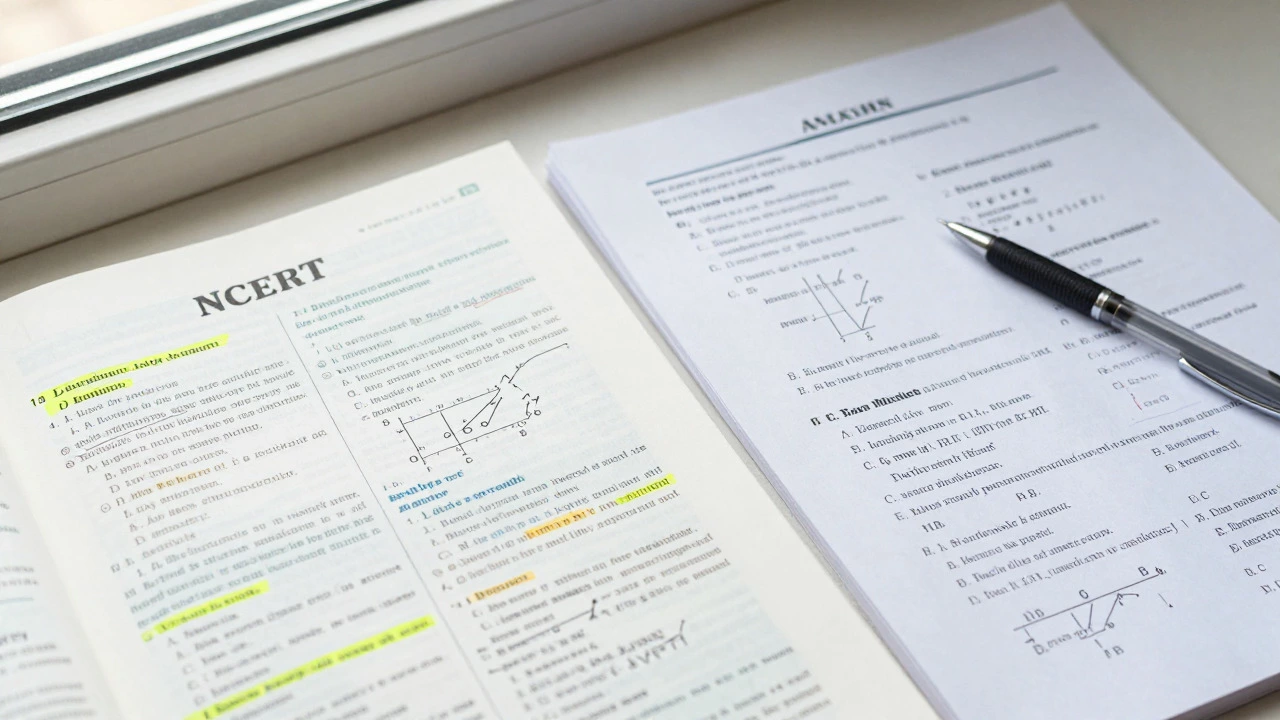
If there is one rule in NEET preparation, it is this: NCERT textbooks, published by the National Council of Educational Research and Training. are the bible for Biology and crucial for Chemistry. In fact, for Biology, nearly 90% of the questions in NEET are directly derived from or heavily inspired by NCERT lines.
Aakash Biology modules are fantastic for expanding your knowledge, but they are not a replacement for NCERT. You will often find that Aakash explains a process in detail, while NCERT presents it in a concise, bullet-point format that matches the exam language. Ignoring NCERT in favor of coaching modules is like reading a commentary instead of watching the game. You get the analysis, but you miss the actual play.
- Biology: Read NCERT Class 11 and 12 line by line. Memorize the exact phrasing. Use Aakash modules only for clarification when a topic feels confusing.
- Chemistry: For Organic and Inorganic Chemistry, NCERT is supreme. Reaction mechanisms, exceptions, and periodic table trends are best learned from here. Use Aakash for Physical Chemistry numericals.
- Physics: NCERT provides the basics, but it is insufficient for the numerical complexity of NEET. Here, Aakash modules are superior, but you still need practice papers.
The Missing Link: Previous Year Questions (PYQs)
You can read every page of Aakash and NCERT, but if you haven't solved past papers, you are unprepared. Previous Year Questions (PYQs) serve as the ultimate diagnostic tool. They reveal patterns. You will notice that certain topics, like Human Physiology or Electrostatics, appear almost every year. Others may be skipped entirely.
Solving PYQs helps you understand the examiner's mindset. Are they testing memory or application? Is the trick in the units or the formula? Aakash does provide some practice questions, but dedicated PYQ books or online databases offer a curated experience of the last 35+ years of exams. This historical data is invaluable. It tells you which chapters carry high weightage and which ones are low-yield.
Moreover, practicing with timed PYQ sets builds the stamina required for the three-hour exam. Many students lose marks not because they don't know the answer, but because they run out of time. Aakash tests help with this, but real exam papers simulate the pressure better than any mock test.
Mock Tests and Error Analysis
Knowledge without assessment is incomplete. Mock tests are the bridge between learning and performing. Aakash offers a rigorous test series, which is a significant advantage. However, taking the test is only half the battle. The real value comes from error analysis.
After every mock test, you must categorize your mistakes: 1. Conceptual Error: You didn't understand the topic. Go back to Aakash modules or NCERT. 2. Careless Mistake: You knew it but misread the question or made a calculation error. This requires focus training. 3. Time Management: You ran out of time. You need to strategize your attempt order.
Without this analysis, you are just repeating the same mistakes. Keep an error log. Write down why you got each question wrong and how to avoid it next time. This personalized feedback loop is something no static book can provide.
When to Add Other Resources
There are specific scenarios where Aakash material falls short, and you should consider adding other resources:
- Weak Foundation: If you struggle with basic concepts, Aakash might feel overwhelming. In this case, use simpler reference books or video lectures to build confidence before diving into Aakash.
- Advanced Aspirants: If you aim for a rank under 100, you might need more challenging problems. Books like H.C. Verma for Physics or O.P. Tandon for Chemistry can provide extra depth.
- Visual Learners: Some students learn better through videos. Platforms like Khan Academy or Unacademy can complement text-based learning.
But beware: do not overload yourself. Switching between too many sources leads to confusion and anxiety. Stick to one primary source (Aakash), one foundational source (NCERT), and one assessment source (PYQs/Mocks).
| Resource | Best For | Limitations | Usage Strategy |
|---|---|---|---|
| Aakash Modules | Conceptual depth, Physics numericals | Too lengthy for quick revision | Primary study material for new topics |
| NCERT Textbooks | Biology facts, Chemistry theory | Lacks complex problem-solving | Daily reading and memorization |
| PYQs | Exam pattern familiarity | Does not teach new concepts | Weekly practice and analysis |
| Mock Tests | Speed, accuracy, stamina | Can be demotivating if scores are low | Bi-weekly full-length simulations |

Creating a Balanced Study Plan
To make the most of Aakash material, integrate it into a structured plan. Do not treat it as a novel to be read cover-to-cover. Treat it as a toolkit.
Start with NCERT to get the overview. Then, use Aakash modules to deepen your understanding, especially in Physics and Chemistry. Solve the examples provided in the modules. Finally, test your knowledge with PYQs. This cycle-Learn, Deepen, Test-should repeat for every chapter.
Revision is key. As the exam approaches, shift your focus from learning new things to revising old ones. Create short notes from Aakash modules for quick review. Highlight important formulas, reactions, and biological terms. These notes become your lifeline in the final weeks.
Common Pitfalls to Avoid
Many students fall into traps that undermine their preparation. One common mistake is neglecting Biology because it seems "easy." In reality, Biology carries the highest weightage (50% of the total marks). Dropping even a few questions here can drop your rank significantly.
Another pitfall is ignoring mental health. NEET preparation is a marathon, not a sprint. Burnout is real. Take breaks, exercise, and sleep well. A tired brain cannot retain information effectively. Remember, consistency beats intensity. Studying six hours daily with focus is better than ten hours of distracted effort.
Also, avoid comparing your progress with others. Everyone learns at their own pace. Focus on your improvement in mock tests rather than someone else's score. Your competition is your previous self.
Final Thoughts on Resource Sufficiency
So, is Aakash material enough for NEET? By itself, no. But combined with NCERT, PYQs, and consistent mock tests, it forms a powerful foundation. The key is not to hoard resources but to master the ones you have. Quality over quantity always wins in competitive exams.
Trust the process. Stick to your plan. And remember, the goal is not just to pass the exam, but to build a strong foundation for your medical career. With the right mix of resources and discipline, you can achieve your dream of becoming a doctor.
Can I crack NEET using only Aakash modules?
It is highly unlikely. While Aakash modules are excellent for conceptual clarity, they lack the direct alignment with NCERT language that is crucial for Biology and Chemistry. Without NCERT and Previous Year Questions (PYQs), you risk missing out on direct factual questions that form a significant portion of the exam.
Which is better for NEET: Aakash or Allen material?
Both Aakash and Allen are top-tier coaching institutes with high-quality material. Aakash is often praised for its detailed explanations and structured approach, while Allen is known for its challenging questions and rigorous test series. The choice depends on your learning style. Try sample modules from both to see which explanation style resonates with you more.
How many times should I revise NCERT Biology?
You should aim to revise NCERT Biology at least 5-7 times before the exam. The first few reads are for understanding, while later revisions focus on memorizing lines, diagrams, and exceptions. Consistent revision ensures that facts remain fresh in your memory during the high-pressure exam environment.
Are Aakash test series sufficient for practice?
Aakash test series is very good for building concept application and speed. However, it should be supplemented with actual Previous Year Questions (PYQs) to understand the exact pattern and difficulty level of the NTA exam. Real exam papers provide insights that mock tests cannot fully replicate.
Should I buy additional reference books for Physics?
For most students, Aakash modules combined with NCERT and PYQs are sufficient for Physics. Additional books like H.C. Verma are beneficial only if you have mastered the basics and want to challenge yourself further. Do not add extra books if you haven't completed the core material thoroughly.
What is the ideal ratio of time spent on Biology vs. Physics/Chemistry?
Since Biology carries 50% of the marks, you should allocate approximately 40-50% of your study time to it. Physics and Chemistry should share the remaining 50-60%. Adjust this ratio based on your strengths and weaknesses, but never neglect Biology as it is the easiest subject to score high marks in.