
Future Path Calculator
Choose what matters most to you and see which educational path aligns better with your goals. The tool compares key factors from the article to help you decide.
Adjust your priorities
Every year, thousands of students in India face a tough choice: stay home and follow the familiar path of CBSE or NEET coaching, or go overseas to study in the USA. It’s not just about prestige or a fancy degree. The real question is: what does your future look like on each side of the world?
Structure of Learning: Rote Memorization vs. Critical Thinking
In India, especially under the CBSE syllabus, the system is built around exams. Students spend years memorizing formulas, dates, and textbook answers. The goal? Score high on board exams, entrance tests like JEE or NEET, and get into one of the few top colleges. There’s little room for curiosity. If your answer doesn’t match the mark scheme, you lose points-even if your logic is solid.
In the USA, classrooms work differently. Teachers don’t just want the right answer. They want to know how you got there. A history class might ask: "What if the Civil War had lasted five more years?" A science class might have you design an experiment to test a theory-not just recite Newton’s laws. Grades come from projects, class discussions, presentations, and essays-not one final exam.
This isn’t theory. A 2023 OECD study found that U.S. students outperformed Indian students in problem-solving tasks by 27%, even when both groups had similar math scores. Why? Because American schools train you to think, not just remember.
Flexibility: One Path vs. Many Paths
In India, your career path often starts at 16. Pick science, commerce, or arts. Stick with it. Switching streams after Class 12 is rare. If you’re in science, you’re expected to become an engineer or doctor. Deviate? People ask, "Why didn’t you go for JEE?"
In the USA, you don’t have to decide until your third year of college. You can start as a biology major, take a creative writing class, realize you love data, and switch to computer science without losing a semester. Colleges let you explore. Many students graduate with double majors, minors, or even degrees in unrelated fields.
And it’s not just about majors. You can take a gap year, work part-time, study abroad for a term, or start a business-all without penalty. In India, taking a year off? It’s seen as falling behind. In the USA? It’s called gaining experience.
Teaching Style: Authority vs. Dialogue
Indian classrooms often follow a top-down model. The teacher is the expert. You listen. You take notes. You rarely question. Asking "Why?" in a lecture hall can feel risky. Many students don’t speak up because they fear being wrong.
In American classrooms, professors expect debate. A student challenging an idea isn’t being disrespectful-they’re showing engagement. Professors often say: "I didn’t think of it that way. Tell me more." Office hours aren’t optional. They’re where real learning happens. You walk in with questions. You leave with clarity.
One Indian student who transferred to a university in Texas told me: "In India, I waited for the answer. In the USA, I learned to ask better questions. That changed everything."
Resources and Access: What You Can Actually Use
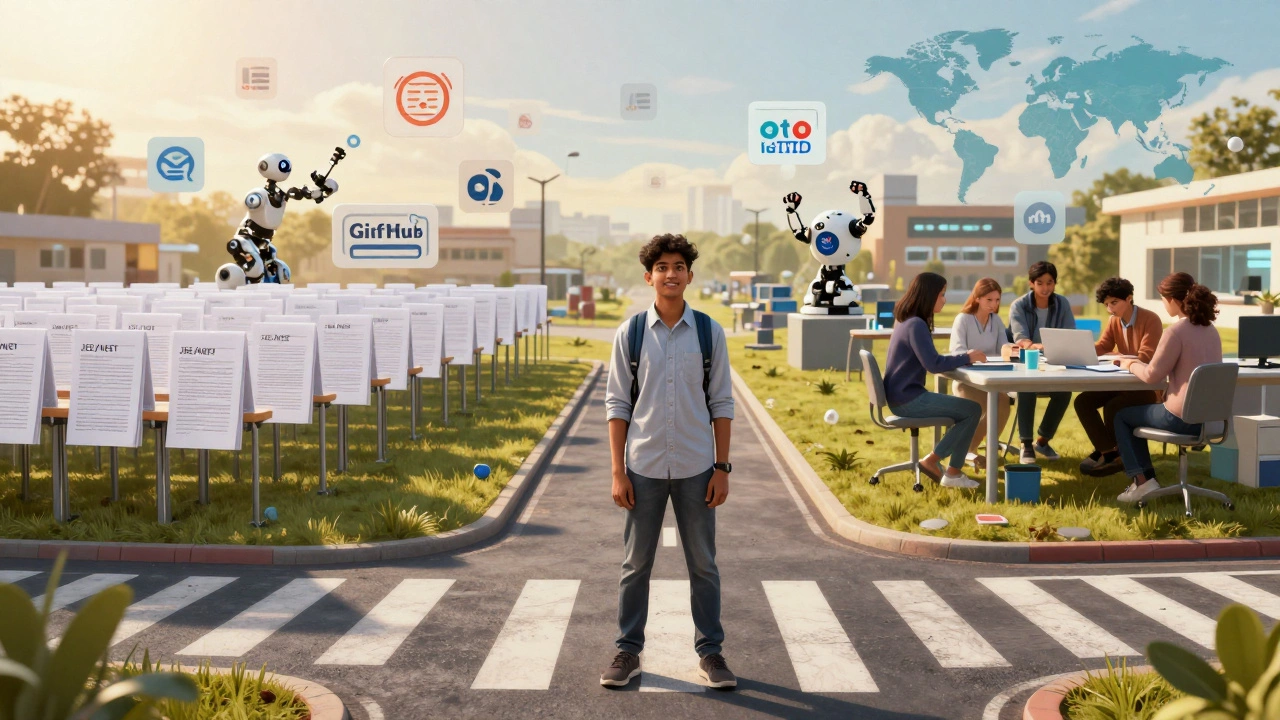
Indian schools, especially outside major cities, often lack labs, libraries, or internet access. Even in well-funded CBSE schools, equipment is outdated. A 2024 government survey found that 42% of CBSE-affiliated schools don’t have functioning science labs.
Meanwhile, U.S. universities invest heavily in resources. At a public university, you might have access to a $2 million robotics lab, free software licenses for design tools, or a research center funded by NASA. Professors often involve undergrads in real projects-not just textbook exercises. You could be analyzing climate data for a state agency or building an app for a local nonprofit.
And it’s not just labs. Libraries in the U.S. give you free access to journals, e-books, and databases like JSTOR and IEEE. In India, many students pay out of pocket for research papers they can’t access otherwise.
Global Exposure: Who You Meet Matters
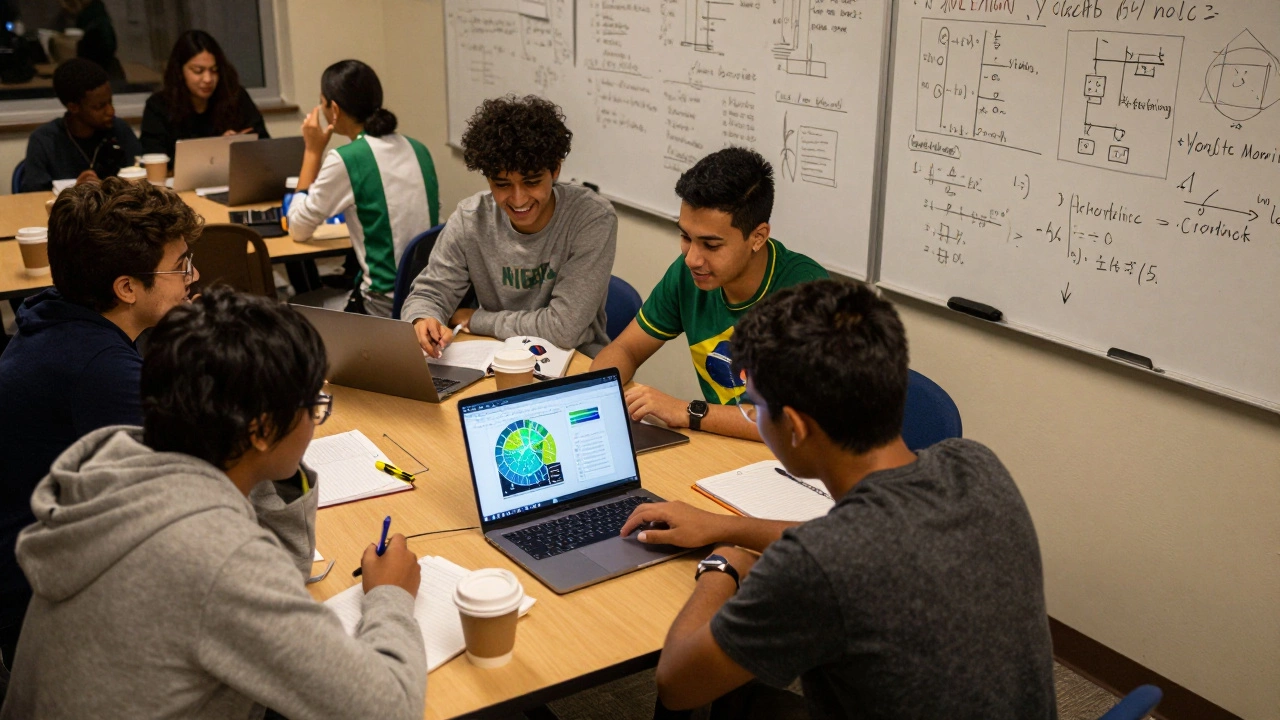
Studying in the USA means sharing a dorm with someone from Nigeria, a lab partner from South Korea, and a roommate from Brazil. You’re not just learning from textbooks-you’re learning from people with different worldviews.
This isn’t just about making friends. It’s about building networks that last. A classmate might start a tech company in Berlin. A professor might connect you to an internship in Silicon Valley. These connections open doors you didn’t even know existed.
In India, most of your peers come from similar backgrounds. Same city, same language, same exam pressure. The diversity is limited. The networks? They stay local.
Post-Graduation: Degrees vs. Opportunities
An Indian degree from a top college like IIT or AIIMS carries weight. But it’s mostly recognized within India. Outside? It’s harder to prove your skills. Employers abroad often ask: "What projects have you done? What have you built?"
U.S. degrees are respected globally. But more importantly, the U.S. system gives you proof of skills-not just grades. Your portfolio, internships, GitHub repo, research paper, or startup can speak louder than your GPA.
Plus, international students in the U.S. can work on-campus without a visa. After graduation, many get a 1-3 year work permit (OPT) to gain real experience. In India, getting a job abroad often means starting from scratch-no work visa, no internship history, no local network.
Cost: It’s Not Just About Fees
Yes, studying in the USA costs more. Tuition can be $30,000-$50,000 a year. Indian public colleges? As low as $500 a year.
But here’s what most people miss: value. In India, you pay less-but you also get less. Limited labs, outdated syllabi, fewer internships, no access to global research. You’re saving money now, but you might be stuck in a narrower career path.
In the USA, scholarships are common. Merit-based aid, need-based grants, teaching assistantships-they exist. Many international students pay far less than the sticker price. And when you graduate with real skills, a global network, and work experience, your earning potential jumps.
A 2025 report from the Institute of International Education showed that U.S. graduates with STEM degrees earned 40% more than their Indian counterparts within five years of graduation.
What’s Right for You?
If you’re someone who thrives under structure, prefers clear rules, and wants to stay close to family, India’s system might suit you. If you want to build something new, challenge ideas, and work with people from every corner of the world, the USA offers a different kind of education.
It’s not about which country is "better." It’s about which system helps you become the person you want to be.
Is the CBSE syllabus accepted in U.S. universities?
Yes, U.S. universities accept CBSE certificates as proof of secondary education. However, they don’t judge you based on your board marks alone. They look at your SAT/ACT scores, extracurriculars, essays, and letters of recommendation. CBSE is just one part of your application.
Can I study in the USA after completing Class 12 in India?
Absolutely. Most U.S. colleges require you to complete 12 years of schooling, which CBSE fulfills. You’ll need to take the TOEFL or IELTS for English proficiency, and either the SAT or ACT for admissions. Many students apply directly after Class 12 and start in the U.S. the following fall.
Do U.S. universities prefer ICSE over CBSE?
No. U.S. admissions officers don’t rank Indian boards. They look at how well you’ve used your opportunities. A CBSE student with strong project work, leadership, and test scores has the same chance as an ICSE student. What matters is your portfolio, not your syllabus.
Is it harder to get into U.S. colleges than Indian ones?
It’s different, not harder. Indian top colleges like IITs use one exam-JEE-to admit thousands. U.S. colleges use a mix of grades, essays, interviews, and extracurriculars. You’re not competing against 1.5 million students for 100 spots. You’re being evaluated as an individual. It’s more holistic, but also more work.
Can I work while studying in the USA?
Yes. International students can work up to 20 hours a week on campus during the term. During breaks, you can work full-time. After graduation, you can apply for Optional Practical Training (OPT), which lets you work in your field for up to three years (especially in STEM fields). This experience is a major advantage over staying in India.
If you’re considering this path, start early. Build a portfolio. Take online courses. Learn to write clearly. Talk to students who’ve made the move. The system you’re in now shapes your present. But the one you choose next? It shapes your future.