JEE Strength Assessment & Strategy Builder
Your JEE Strength Assessment
Rate your confidence and understanding in each subject (1 = lowest, 5 = highest)
There’s no single "best" subject in IIT JEE preparation - but there is a best strategy for you. Thousands of students chase the myth that physics is the hardest, or that math is the most scoring, or that chemistry is the easiest way to boost marks. The truth? It’s not about which subject is best. It’s about which subject you can turn into your strongest weapon.
Why "best subject" is a trap
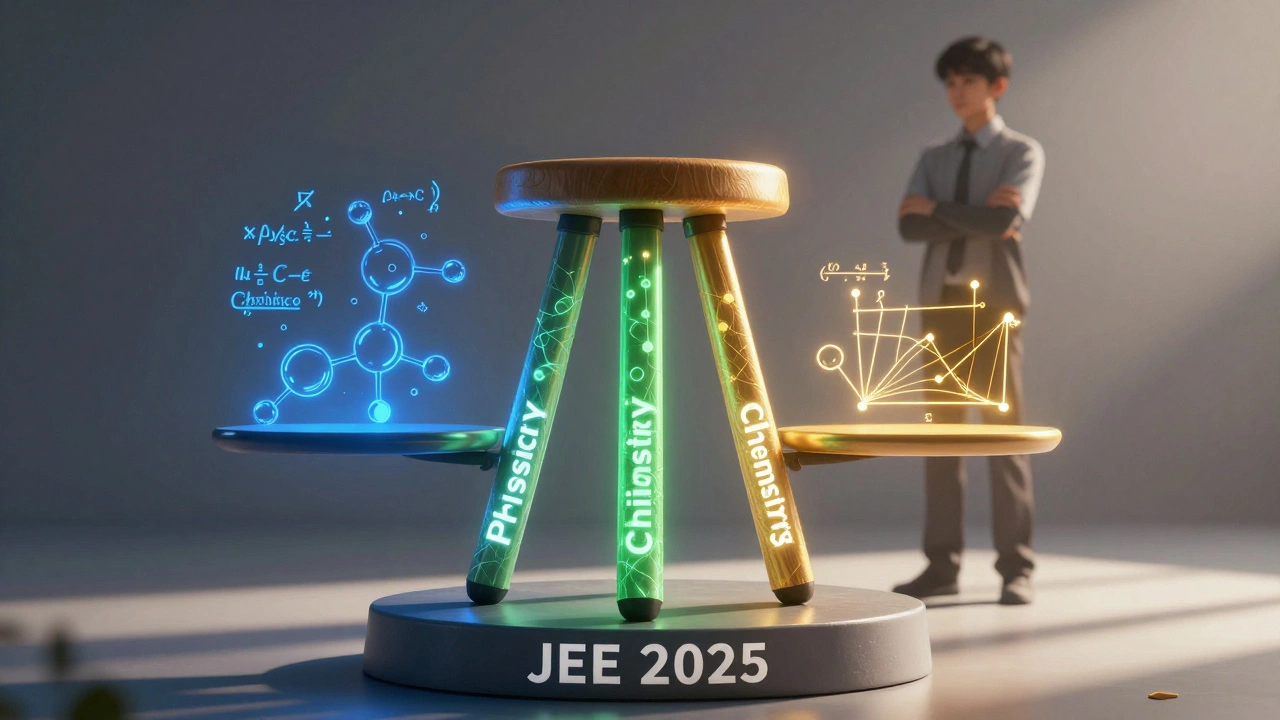
The moment you ask "Which IIT subject is best?", you’re already falling into a common trap. You’re looking for a shortcut. But JEE doesn’t reward shortcuts. It rewards balance. The exam is designed to test your ability to handle all three: physics, chemistry, and mathematics. Your final score is the sum of all three sections. No matter how good you are in one, a weak performance in another will drag you down.Think of it like a three-legged stool. If one leg is too short, the whole thing wobbles. In 2025, the average JEE Advanced cutoff for top IITs was around 68% overall. Students who scored 85% in math but only 50% in chemistry didn’t make the cut. Not because they weren’t smart - because they didn’t manage their strengths properly.
Mathematics: The score multiplier
Math is where you can gain the most ground - if you’re disciplined. It’s predictable. The patterns repeat. The same types of problems show up year after year: limits, matrices, coordinate geometry, calculus, probability. If you master these, you can reliably score 80-90% in math.Here’s what works: solve 20-25 problems daily from past papers. Don’t just read solutions. Write them out. Time yourself. In 2024, a student from Delhi improved from 45% to 88% in math in just four months by doing this. He didn’t take extra coaching. He just practiced smart. Math rewards consistency more than genius.
But here’s the catch: if you hate math, don’t force it. Many students waste months trying to "love" math because they heard it’s "the most important." That’s dangerous. If you’re stressed every time you open a calculus problem, your brain shuts down. That’s when you start making silly mistakes - the kind that cost you 10+ marks.
Chemistry: The low-effort, high-reward subject
Chemistry is the quiet hero of JEE. It’s the subject where you can gain the most points with the least effort. Organic chemistry? Memorize reaction pathways. Inorganic? Learn the periodic table trends. Physical chemistry? Master the formulas - they’re fewer than you think.In 2025, nearly 60% of chemistry questions in JEE Advanced came from just three areas: chemical bonding, equilibrium, and organic name reactions. That’s it. If you know those cold, you can score 35+ out of 40 in chemistry - even if you’re not a science prodigy.
Students who treat chemistry as "just memorization" lose. Those who treat it as "pattern recognition" win. For example, once you see that all SN1 reactions follow the same carbocation stability order, you don’t need to memorize 50 reactions. You just need to understand the logic. Chemistry is the subject where you can turn rote learning into real understanding.
Physics: The thinking subject
Physics is where you’ll feel the most pressure. It’s not about formulas - it’s about applying them. A question might ask you to find the tension in a rope hanging from a pulley while a block slides on an inclined plane - all while friction and air resistance are involved. That’s not a formula recall. That’s a mental puzzle.But here’s what most students miss: physics is also the most logical. Once you understand Newton’s laws, energy conservation, and Kirchhoff’s rules, you can solve 80% of the problems without memorizing anything. The trick? Build intuition. Draw diagrams. Ask: "What’s changing? What’s conserved?"
A student from Kota scored 82% in physics in 2025 by doing one thing: solving every single past paper question from 2010-2024. Not once. Not twice. Three times. Each time, he asked: "Why does this work?" Not "How do I solve it?" That’s the difference between memorizing and mastering.
What top performers actually do
The top 1% of JEE rankers don’t spend 12 hours a day studying. They spend 6-7 hours - but those hours are laser-focused. Here’s what they do:- They identify their weakest subject and attack it first, not last.
- They don’t chase "easy" subjects. They chase "predictable" ones.
- They solve 10-15 full-length mock tests before the exam - not 50.
- They review mistakes, not just answers. Every error is a lesson.
- They sleep 7+ hours. No exceptions.
In 2024, a student from Jaipur ranked 127th in JEE Advanced. He started with physics as his weakest subject. He spent 60% of his study time on it for three months. By the end, he was scoring 85% in physics, 80% in math, and 78% in chemistry. He didn’t have the highest marks in any one subject. But he had the most consistent score across all three.

Your personal strategy
Here’s how to find your best subject - the one that will carry you:- Take a diagnostic test for all three subjects. Don’t study first. Just see where you stand.
- Identify which subject you can solve problems in with the least mental resistance.
- That’s your anchor. Build confidence there first.
- Then, use that confidence to tackle your weakest subject - not by cramming, but by understanding.
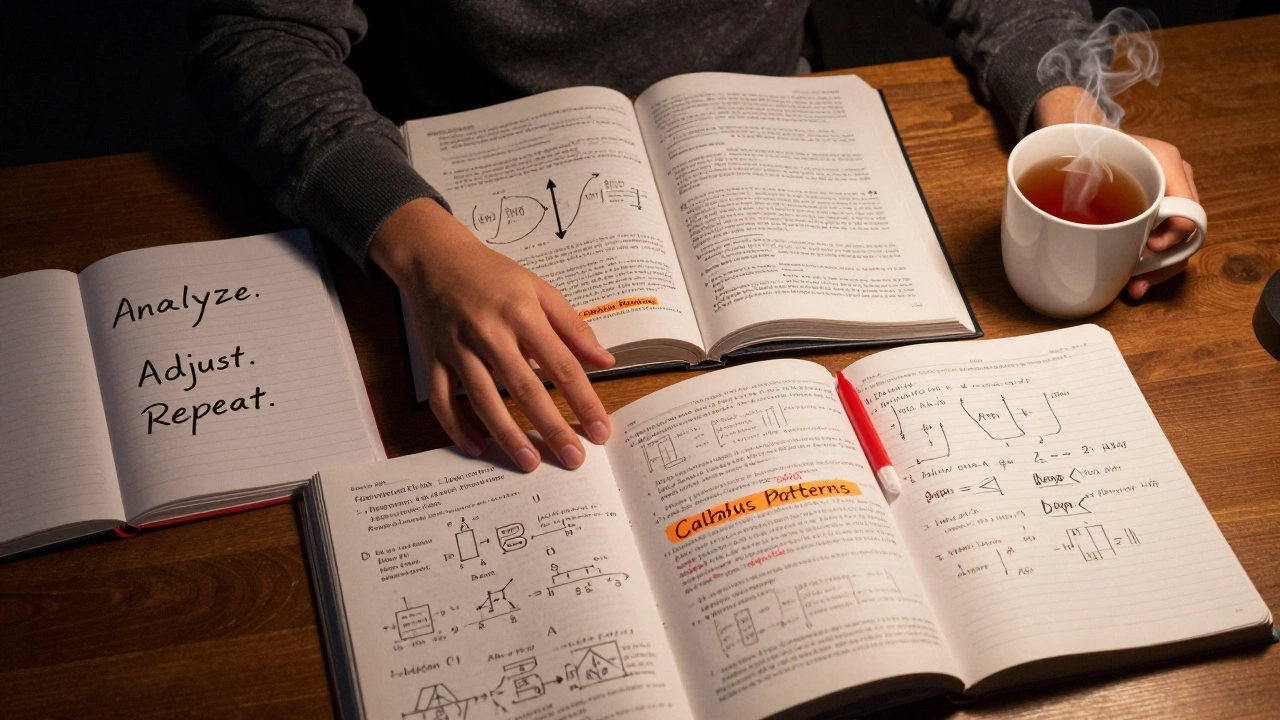
- Repeat: practice, analyze, adjust.
Don’t ask "Which subject is best?" Ask: "Which subject can I turn into my advantage?"
Common mistakes to avoid
- Ignoring chemistry because "it’s just memorization." That’s how you lose 30+ marks.
- Skipping physics because "it’s too hard." That’s how you get stuck at 5000 rank.
- Over-focusing on math because "everyone says it’s important." But if you hate it, you’ll burn out.
- Trying to master every topic. Focus on high-yield areas. 20% of topics give you 80% of marks.
Final truth
There is no best subject. There is only the subject you stop fearing. The one you learn to enjoy. The one you can solve after midnight because you’re curious - not because you have to.Some students win because they’re naturally good at math. Others win because they turned chemistry into a game. The ones who don’t make it? They spent years chasing the idea of a "best subject" - instead of building their own path.
Is physics the hardest subject in JEE?
Physics is often seen as the hardest because it requires deep conceptual understanding. But difficulty is personal. For some, the math-heavy problems in physics are easy. For others, the abstract nature of topics like electromagnetism or modern physics is challenging. The key isn’t to avoid physics - it’s to build intuition through problem-solving, not memorization.
Can I skip chemistry and still get into IIT?
No. Chemistry is not optional. Even if you score 95% in math and physics, a score below 40% in chemistry will likely keep you out of top IITs. Chemistry questions are predictable and high-yield. With focused preparation, you can score 35+ out of 40 in chemistry - even if you’re not a science student by nature.
Should I focus more on math if I’m good at it?
Yes - but only after you’ve stabilized your weakest subject. Math gives you the highest scoring potential, but JEE is a three-subject exam. If your chemistry or physics is weak, your overall score will suffer. Use your strength in math to build momentum, but don’t neglect the others. Balance wins.
How many hours should I study each subject daily?
There’s no fixed number. What matters is quality. A student who spends 2 focused hours on chemistry (solving 15 problems + reviewing mistakes) will outperform someone who studies 4 hours without focus. Prioritize depth over hours. Aim for 2-3 hours per subject daily, adjusting based on your progress.
Is coaching necessary to crack JEE?
No. Many top rankers in 2024 and 2025 didn’t attend coaching centers. They used free online resources, past papers, and disciplined self-study. Coaching helps if you need structure - but it’s not a magic solution. Your consistency, self-analysis, and problem-solving habits matter far more than the name of your coaching institute.