
JEE Chemistry Difficulty Diagnostic Tool
Identify Your Personal "Toughest" Chapter
Answer these questions honestly to discover which branch challenges you most and get targeted strategies.
Your Diagnostic Result
Difficulty Intensity Score
Why This Branch Challenges You:
Targeted Strategy to Conquer It:
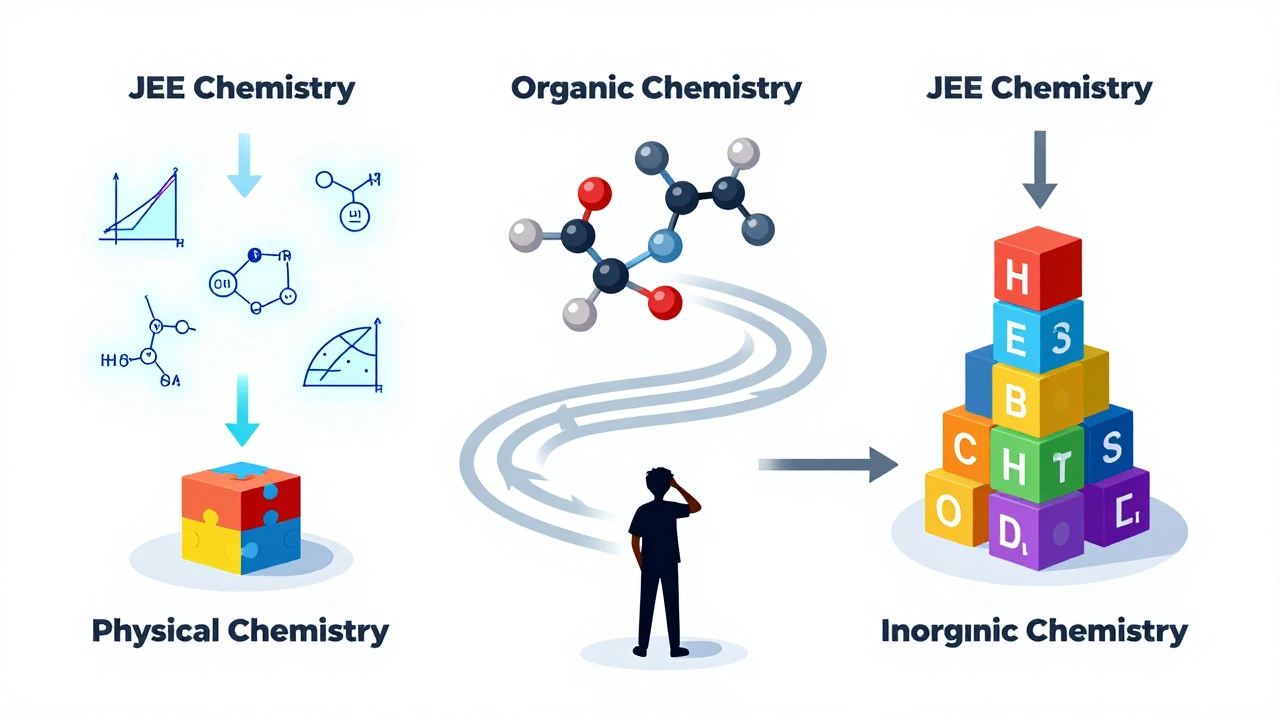
Every year, thousands of students staring at their study plans ask the same question: "Which chapter will break me?" When it comes to JEE Chemistry is the chemistry component of the Joint Entrance Examination, a highly competitive engineering entrance test in India that tests conceptual depth and application speed, there is no single answer. The "toughest" chapter depends entirely on your strengths. If you hate math, Physical Chemistry feels like a nightmare. If you struggle with logic, Organic Chemistry seems impossible. And if you can't memorize patterns, Inorganic Chemistry becomes a trap.
The truth is, difficulty is subjective. However, based on data from top coaching institutes and analysis of past papers from NTA is National Testing Agency, the body responsible for conducting JEE Main and other national level exams in India and IISc/IITs are Indian Institutes of Science and Technology, the institutions that set the paper for JEE Advanced, known for high-level problem setting, certain topics consistently cause the most drops in scores. Let’s look at why specific chapters feel harder than others and how to handle them without burning out.
Why Physical Chemistry Feels Like Math Class
For many students, Physical Chemistry is a branch of chemistry that applies physics principles to chemical systems, focusing on thermodynamics, kinetics, and quantum mechanics is the hardest part of the syllabus. Why? Because it isn’t just about remembering facts. It requires you to solve numerical problems quickly and accurately. If your foundation in calculus or algebra is weak, topics like Chemical Kinetics is the study of reaction rates and mechanisms, involving complex differential equations and order of reactions or Thermodynamics is the study of energy transfer and entropy changes in chemical processes, requiring strong understanding of state functions will feel insurmountable.
In JEE Advanced, questions often combine multiple concepts. You might need to use equilibrium constants alongside Le Chatelier's principle while calculating pH values. One small calculation error ruins the whole answer. Students who find this tough usually lack practice in dimensional analysis or unit conversions. It’s not that the concept is hard; it’s that the execution demands precision under time pressure.
- Chemical Equilibrium: Requires balancing multiple simultaneous reactions.
- Electrochemistry: Involves Nernst equation calculations and cell potential logic.
- Solid State: Demands 3D visualization and crystal lattice math.
If you enjoy solving puzzles and don’t mind using formulas, Physical Chemistry might actually be your easiest section. But if numbers make you anxious, this branch will feel like the toughest hurdle.
The Labyrinth of Organic Chemistry
On the flip side, Organic Chemistry is the study of carbon-containing compounds, focusing on structure, properties, composition, reactions, and synthesis terrifies students who rely on rote memorization. Unlike Physics, where laws are universal, Organic Chemistry is full of exceptions. You learn a rule, then immediately encounter a reaction that breaks it because of steric hindrance or electronic effects.
The real challenge here is Reaction Mechanisms are step-by-step descriptions of how bonds break and form during a chemical reaction, showing electron movement via curved arrows. You can’t just memorize "A turns into B." You need to understand why electrons move from one atom to another. Topics like General Organic Chemistry (GOC) is the foundational unit covering acidity, basicity, resonance, and inductive effects, essential for predicting reactivity act as the gateway. If you don’t master GOC, everything else-Aldehydes and Ketones are carbonyl compounds that undergo nucleophilic addition reactions, a frequent topic in JEE Advanced organic sections, Aromatic Compounds are stable ring structures like benzene that undergo electrophilic substitution, requiring deep understanding of directing groups, and Biomolecules are large biological molecules including proteins, carbohydrates, and nucleic acids, tested for structural identification-will seem random.
Students who find Organic Chemistry tough often try to memorize every reaction individually. This fails in JEE because examiners love creating new scenarios. You need to think like a chemist, not a parrot. Visualizing electron flow is key. If you can draw the mechanism correctly, the product follows naturally.
The Memory Trap of Inorganic Chemistry
Many students claim Inorganic Chemistry is the study of inorganic compounds, including metals, non-metals, and coordination complexes, often perceived as memory-heavy is the easiest because it’s mostly theory. They’re wrong. It’s the most deceptive. In JEE Main, you might get direct factual questions. But in JEE Advanced, they twist these facts into logical puzzles.
The toughest parts are usually Coordination Compounds are complexes formed by metal ions and ligands, involving hybridization, magnetic properties, and isomerism and Periodic Table Trends are patterns in atomic radius, ionization energy, and electronegativity across periods and groups, critical for predicting behavior. Why? Because you have to remember hundreds of data points: colors of precipitates, oxidation states, stability orders, and exception rules. For example, knowing that Copper(II) sulfate is blue is easy. Knowing why Chromium(VI) is unstable compared to Molybdenum(VI) requires deeper reasoning.
Another major pain point is Qualitative Analysis is the process of identifying cations and anions through characteristic reactions, a traditional but still relevant JEE topic. You need to recall which reagent produces which color change instantly. If you forget one step in a long sequence of tests, you lose marks. This section rewards consistent revision over last-minute cramming.
| Branch | Primary Challenge | Key Skill Required | Typical Pitfall |
|---|---|---|---|
| Physical Chemistry | Numerical accuracy | Mathematical application | Calculation errors under time pressure |
| Organic Chemistry | Logical deduction | Mechanism understanding | Rote memorization without context |
| Inorganic Chemistry | Volume of facts | Pattern recognition | Confusing similar-looking trends |
How to Identify Your Personal "Toughest" Chapter
Instead of worrying about what others find hard, look at your own performance. Take a diagnostic test covering all three branches. Analyze your mistakes:
- Did you run out of time? If yes, Physical Chemistry numericals might be slowing you down.
- Did you guess randomly? If yes, you likely lack conceptual clarity in Organic mechanisms or Inorganic trends.
- Did you know the concept but apply it wrong? This suggests a gap in understanding exceptions, common in Inorganic Chemistry.
Your weakest area is your personal toughest chapter. Focus there first. Don’t ignore it hoping it will go away. In JEE, every mark counts, and skipping a "hard" chapter means leaving free points on the table if you had studied smarter.
Strategies to Conquer the Hardest Topics
Once you’ve identified your bottleneck, attack it with targeted strategies. Here’s how top rankers handle the heavy hitters:
For Physical Chemistry: Practice units and dimensions daily. Solve previous years' questions (PYQs) from both JEE Main and Advanced. Focus on derivations, not just final formulas. Understanding where a formula comes from helps you reconstruct it if you forget it during the exam.
For Organic Chemistry: Draw mechanisms by hand every day. Use color-coded pens for electron donors and acceptors. Group reactions by functional group rather than chapter name. Create flowcharts connecting reactants to products via intermediates. This builds mental maps instead of isolated facts.
For Inorganic Chemistry: Make short notes with mnemonics. Use NCERT textbooks as your bible-most JEE Main questions come directly from its lines. For Advanced, refer to standard books like JD Lee for deeper explanations. Revise weekly using flashcards for quick recall of colors, formulas, and trends.
Consistency beats intensity. Studying 30 minutes daily for each branch is better than 5 hours once a week. Your brain needs sleep to consolidate memories, especially for Inorganic facts.
Common Myths About JEE Chemistry Difficulty
There are several misconceptions that add unnecessary stress. Let’s clear them up:
Myth 1: "Organic Chemistry is purely memorization."
Reality: While some facts must be remembered, the core is logic. Once you understand electron movement, you can predict unknown reactions. Memorization alone fails in tricky Advanced questions.
Myth 2: "Physical Chemistry is only for math geniuses."
Reality: Most calculations involve basic algebra and logarithms. With regular practice, anyone can improve speed and accuracy. It’s more about familiarity than genius.
Myth 3: "Inorganic Chemistry has no logic."
Reality: There are underlying reasons for trends, such as effective nuclear charge and shielding effects. Understanding these principles reduces the amount of pure memorization needed.
Believing these myths makes you approach the subject with fear. Replace fear with curiosity. Ask "why" before asking "what."
Final Thoughts on Mastering JEE Chemistry
The toughest chapter in JEE Chemistry is the one you avoid. Whether it’s the numericals in Thermodynamics, the mechanisms in Aldehydes, or the facts in p-Block Elements, avoidance guarantees failure. Engagement brings mastery.
Remember, JEE doesn’t test who knows the most obscure fact. It tests who can apply fundamental concepts creatively and accurately. By breaking down each branch into manageable pieces, practicing actively, and analyzing your errors, you turn "tough" into "manageable." Start today. Pick one difficult topic and spend an hour understanding it deeply. You’ll be surprised how much clearer it becomes when you stop running from it.
Is Organic Chemistry harder than Physical Chemistry for JEE?
It depends on your background. If you are strong in mathematics and enjoy problem-solving, Physical Chemistry may feel easier. If you prefer logical reasoning and visual thinking, Organic Chemistry might be more intuitive. However, Organic Chemistry is often considered tougher due to the vast number of reactions and exceptions, whereas Physical Chemistry relies on fewer, more universal principles applied numerically.
Which chapter of Inorganic Chemistry is the most difficult?
Coordination Compounds is widely regarded as the most challenging chapter in Inorganic Chemistry for JEE. It involves complex concepts like Crystal Field Theory, hybridization, isomerism, and magnetic properties. Additionally, Qualitative Analysis requires extensive memorization of reagents and observations, making it another high-difficulty area.
Can I crack JEE Advanced by skipping the toughest chapters?
Skipping chapters is risky. JEE Advanced papers are unpredictable, and any topic can appear. While you might manage with JEE Main by focusing on high-weightage areas, Advanced requires comprehensive knowledge. Instead of skipping, identify weak areas and strengthen them gradually. Even mastering basic concepts in tough chapters can yield significant marks.
How much time should I dedicate to Chemistry for JEE preparation?
Most successful candidates spend 2-3 hours daily on Chemistry. This includes 1 hour for reading theory, 1 hour for solving problems, and 30 minutes for revision. Consistency is key. Regular exposure ensures that concepts remain fresh and problem-solving speed improves over time.
Are NCERT books enough for JEE Chemistry?
NCERT is essential, especially for Inorganic Chemistry and JEE Main. However, for JEE Advanced, you need reference books for deeper understanding and practice. Books like OP Tandon for Physical Chemistry, MS Chouhan for Organic Chemistry, and JD Lee for Inorganic Chemistry are recommended supplements to NCERT.