If you’ve ever stared at a screen full of online course platforms and felt overwhelmed, you’re not alone. With so many options claiming to be the "best," it’s hard to know where to start. The truth? There’s no single best platform for everyone. What works for a graphic designer learning Adobe Illustrator won’t work for a nurse preparing for certification, or a small business owner trying to master digital marketing. The right platform depends on your goals, budget, and how you learn best.
What makes a platform "best"?
Before comparing platforms, think about what you actually need. Are you looking to pick up a new skill for fun? Get a certificate for your resume? Earn a degree? Or just finish a single course before your next job interview?
Some platforms focus on professional credentials. Others are built for casual learners. A few offer live classes with real instructors. Some are packed with videos and quizzes. Others give you access to industry experts or peer feedback. The "best" platform is the one that matches your learning style and outcome.
Here’s what to look for:
- Certification value - Does the certificate mean anything to employers?
- Course depth - Is it a 30-minute intro or a 10-week deep dive?
- Instructor credibility - Are the teachers industry pros or just content creators?
- Learning support - Do you get feedback, forums, or live Q&As?
- Cost structure - One-time payment? Subscription? Free with paid upgrades?
Udemy: The wide net
Udemy is the biggest marketplace for online courses. You’ll find over 215,000 courses on everything from Python to pottery. It’s cheap - courses often drop to under $15 during sales. You own them forever, no subscription needed.
But here’s the catch: quality varies wildly. Anyone can upload a course. Some are polished, professional, and taught by experts. Others are rushed, poorly edited, and full of outdated info. You have to sift through reviews and preview videos to find the good ones.
Udemy doesn’t offer accredited certificates. Employers don’t recognize them. But if you’re learning for personal growth or to add a skill to your LinkedIn profile, it’s hard to beat the price and variety.
Coursera: The credential king
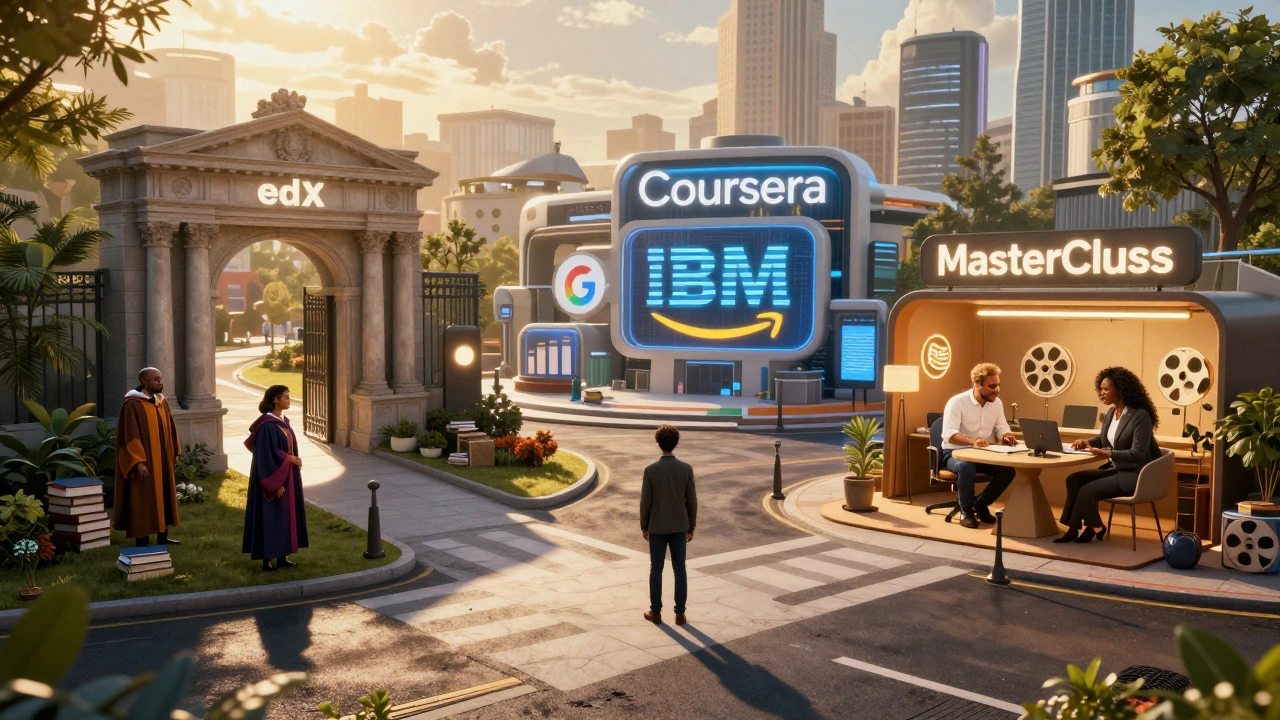
Coursera partners with universities like Stanford, Yale, and the University of London. It’s where you go if you want something that looks good on a resume. Many courses offer professional certificates, Specializations, and even full online degrees.
Its partnership with Google, IBM, and Meta means you can earn industry-recognized certs in data analytics, project management, or UX design - all without a college degree. These are accepted by thousands of employers worldwide.
The downside? Coursera’s pricing is tricky. You can audit most courses for free, but you won’t get graded assignments, feedback, or a certificate. To unlock those, you need to pay $49-$99 per course, or subscribe monthly for $59. If you’re going for a Specialization or degree, you’re looking at $300-$15,000.
For serious learners chasing career advancement, Coursera still leads.
edX: The academic choice
Founded by MIT and Harvard, edX leans hard into academia. It’s the go-to if you want university-level rigor without enrolling in a degree program. You’ll find courses from top schools like Berkeley, MIT, and the University of Tokyo.
edX offers MicroMasters programs - graduate-level credentials that can sometimes be applied toward a full master’s degree. Some are free to audit. Others cost $500-$1,000 for verified certificates.
Unlike Coursera, edX doesn’t push corporate certifications. It’s more about deep learning than job-ready skills. If you’re a student, a researcher, or someone who values academic credibility over industry buzzwords, edX is a strong pick.
LinkedIn Learning: For professionals on the go
LinkedIn Learning used to be Lynda.com. It’s now deeply tied to your professional profile. Every course you finish shows up on your LinkedIn feed. That’s powerful - recruiters see it. Hiring managers notice it.
The library has over 16,000 courses focused on business, tech, and creative skills. The videos are short, clean, and practical. Most are under 10 minutes. Perfect for learning during lunch breaks or commutes.
It’s included with a LinkedIn Premium subscription ($29.99/month). If you’re already paying for Premium, it’s a no-brainer. If not, the cost adds up fast. It’s not for deep dives or certifications. But if you want to quickly upskill and make it visible to employers, it’s unmatched.
MasterClass: The inspiration factor
MasterClass isn’t about teaching you how to code or manage a budget. It’s about learning from the best in the world - Gordon Ramsay on cooking, Serena Williams on tennis, Neil Gaiman on storytelling.
The production value is cinematic. The instructors aren’t educators - they’re icons. You’re not getting step-by-step tutorials. You’re getting insight, mindset, and creative philosophy.
It’s expensive at $180/year for unlimited access. But if you’re looking for motivation, inspiration, or a new perspective, it’s unique. It won’t get you a job. But it might change how you think about your work.
Platform comparison: Quick snapshot
| Platform | Best for | Cost | Certificates | Learning style |
|---|---|---|---|---|
| Udemy | Self-paced learners, hobbyists | $10-$200 per course | Yes, but not accredited | Video-heavy, self-directed |
| Coursera | Career changers, job seekers | $49-$99/course or $59/month | Yes, employer-recognized | Structured, graded, project-based |
| edX | Academic learners, researchers | Free to audit; $500-$1,000 for certs | Yes, university-backed | University-style, theory-heavy |
| LinkedIn Learning | Professionals with LinkedIn profiles | $29.99/month (with Premium) | Yes, auto-syncs to LinkedIn | Short, practical, skill-focused |
| MasterClass | Inspiration, creativity | $180/year | No | Story-driven, observational |
Who should use what?
Let’s cut through the noise. Here’s who wins with each platform:
- If you want a certificate that employers recognize - Go with Coursera. Their Google and IBM certs are trusted by companies like Deloitte, Google, and Amazon.
- If you’re on a tight budget and just want to learn - Udemy. Wait for a sale. Pick a course with 4.5+ stars and 10,000+ reviews.
- If you’re already on LinkedIn Premium - Use LinkedIn Learning. It’s free with your subscription and boosts your profile.
- If you’re aiming for grad school or academic credibility - edX. Their MicroMasters can count toward real degrees.
- If you need motivation, not instruction - MasterClass. It’s not a course - it’s a masterclass in thinking like a pro.
What most people get wrong
Many people think the best platform is the one with the most courses. That’s not true. It’s the one that keeps you going.
Studies show that people who finish online courses are more likely to have:
- A clear goal (not just "learn something")
- Accountability (a deadline, a study group, a mentor)
- Immediate application (using the skill within 2 weeks)
That’s why platforms like Coursera and LinkedIn Learning win - they build structure into the experience. Udemy gives you freedom. But freedom without structure leads to abandoned courses.
Also, don’t ignore free options. Many universities offer free courses through their websites. MIT OpenCourseWare, Stanford Online, and Harvard’s free CS50 course are world-class. You won’t get a certificate, but you’ll learn from the best.
Final tip: Try before you commit
Most platforms let you audit a course for free. Use that. Watch the first three videos. Read the reviews. See if the instructor’s style clicks with you. If you’re not excited after 15 minutes, move on.
The best platform isn’t the one with the fanciest website. It’s the one you actually complete. Pick the one that fits your life, your goals, and your attention span. Then stick with it.
Is Udemy worth it in 2025?
Yes, if you’re learning for personal growth or to add a skill to your resume. Udemy’s courses are cheap and varied, but the certificates aren’t accredited. Only buy courses with high ratings (4.5+) and lots of reviews. Avoid courses older than 2023 unless they’re in a stable field like Excel or basic accounting.
Can I get a degree from an online course platform?
Yes, but only through Coursera and edX. They partner with universities to offer full online bachelor’s and master’s degrees. These cost $10,000-$25,000, but they’re accredited and recognized just like on-campus degrees. Most require an application process, not just payment.
Are LinkedIn Learning certificates valuable?
They’re valuable for visibility, not accreditation. Employers don’t treat them like college degrees, but they do notice them on LinkedIn profiles. If you’re job hunting, finishing a course and adding it to your profile can increase your chances of getting noticed by recruiters by up to 30%, according to LinkedIn’s internal data.
What’s the cheapest way to learn online?
Use free resources: MIT OpenCourseWare, Stanford Online, YouTube channels like freeCodeCamp and CrashCourse, and public library offerings like Kanopy. You won’t get certificates, but you’ll get high-quality education at zero cost. Many people learn programming, design, and business skills this way.
Do I need to pay for a subscription?
No, not unless you’re taking multiple courses over time. Udemy and edX let you pay per course. Coursera and LinkedIn Learning push subscriptions - only go that route if you plan to take 3+ courses in a few months. Otherwise, pay-as-you-go saves money.
Which platform is best for beginners?
LinkedIn Learning and Udemy are easiest for beginners. Courses are short, clear, and don’t assume prior knowledge. Coursera and edX can be overwhelming if you’re new to online learning - their structure feels more academic. Start with a 30-minute intro course on LinkedIn or a top-rated Udemy class before tackling longer programs.