
MBA Financial ROI Calculator
MBA Financial ROI Calculator
Determine if an MBA is financially worthwhile for your career path. Input your specific situation to calculate the true return on investment.
ROI Analysis Results
Total Cost
Salary Difference
Loan Repayment Time
Net Financial Impact
More people are asking: is an MBA worth it anymore? In the past, walking into a boardroom with an MBA meant you’d already proven you could climb the corporate ladder. Today, that’s not always true. The cost, time, and opportunity cost of an MBA can outweigh the benefits-especially if you’re not heading into finance, consulting, or a legacy industry. Let’s cut through the hype and look at what most MBA brochures won’t tell you.
The price tag doesn’t just include tuition
A top-tier MBA in the U.S. or U.K. can cost anywhere from $100,000 to $200,000 when you add tuition, living expenses, and lost income. That’s not a loan. That’s a financial commitment that can take over a decade to pay off. The average MBA graduate in 2025 carries $125,000 in student debt. Meanwhile, the median starting salary for MBA grads in consulting or finance is around $135,000. That sounds good-until you realize you’re paying $1,000 a month in student loans for the next 10 years. And if you end up in marketing, operations, or tech, your salary might be closer to $85,000. That’s not a return on investment. That’s a financial trap.And it’s not just the money. You’re giving up two full years of career momentum. If you’re 28 and take a break to do an MBA, you’re skipping promotions, skipping raises, and missing out on real-world experience that no classroom can replicate. People who stay in the workforce often out-earn MBA grads by their mid-30s-not because they’re smarter, but because they kept building.
It doesn’t guarantee a better job
MBA programs love to show off their job placement stats. But those numbers are misleading. They count anyone who takes *any* job within three months-even if it’s part-time, freelance, or just a step sideways. The real question is: did the MBA get you a *better* job? A 2024 survey of 12,000 MBA alumni found that 41% said their MBA didn’t change their career trajectory at all. Another 27% said they’d have been better off staying in their current role.Many grads end up in roles they could’ve gotten without the degree. A project manager with five years of experience and a solid track record doesn’t need an MBA to move into senior leadership. Companies are hiring based on skills now, not diplomas. LinkedIn data shows that 68% of hiring managers in tech and startups say they value demonstrable results over an MBA credential.
The network isn’t what you think
You’ve heard the pitch: “Your MBA classmates will become your future CEOs.” But here’s the truth: most people in your cohort are just like you-ambitious, anxious, and trying to figure out their next move. Only a small fraction end up in positions where they can actually help you. And even then, connections don’t automatically translate to opportunities.Real networks are built over time through consistent work, not a two-year program. I’ve seen people with Harvard MBAs struggle to get interviews, while others with no degree but a strong portfolio and public track record land roles at top firms. The MBA network is only valuable if you already know how to leverage it. If you’re relying on it to open doors, you’re setting yourself up for disappointment.

It’s outdated for fast-moving industries
MBA curriculums haven’t changed much since the 1990s. You’ll still spend weeks on Porter’s Five Forces, SWOT analysis, and discounted cash flow models. But how many startups use those tools? How many tech companies rely on quarterly financial forecasts instead of agile experimentation? In AI, SaaS, or e-commerce, speed and iteration beat theoretical frameworks every time.One founder I know hired two MBA grads from Stanford. Both were brilliant on paper. But they spent three months analyzing market size before launching a simple product. Meanwhile, a 23-year-old with no degree built a prototype in two weeks, got 10,000 users, and raised $2 million. The MBA grads were stuck in analysis paralysis. The industry doesn’t need more analysts. It needs doers.
High dropout and regret rates
It’s not just about cost or job outcomes. Many people drop out-or wish they had. A 2025 study by the Graduate Management Admission Council found that 32% of MBA students reported feeling regret by the end of their first year. Reasons? Burnout, isolation, mismatched expectations, and realizing they didn’t actually want to work in corporate environments.Women and international students report even higher regret rates. Many international students take on massive debt only to find visa restrictions limit their job options. Women often face a culture that still favors male leadership styles, making it harder to thrive. And if you’re not naturally drawn to finance or strategy, the curriculum can feel irrelevant and draining.
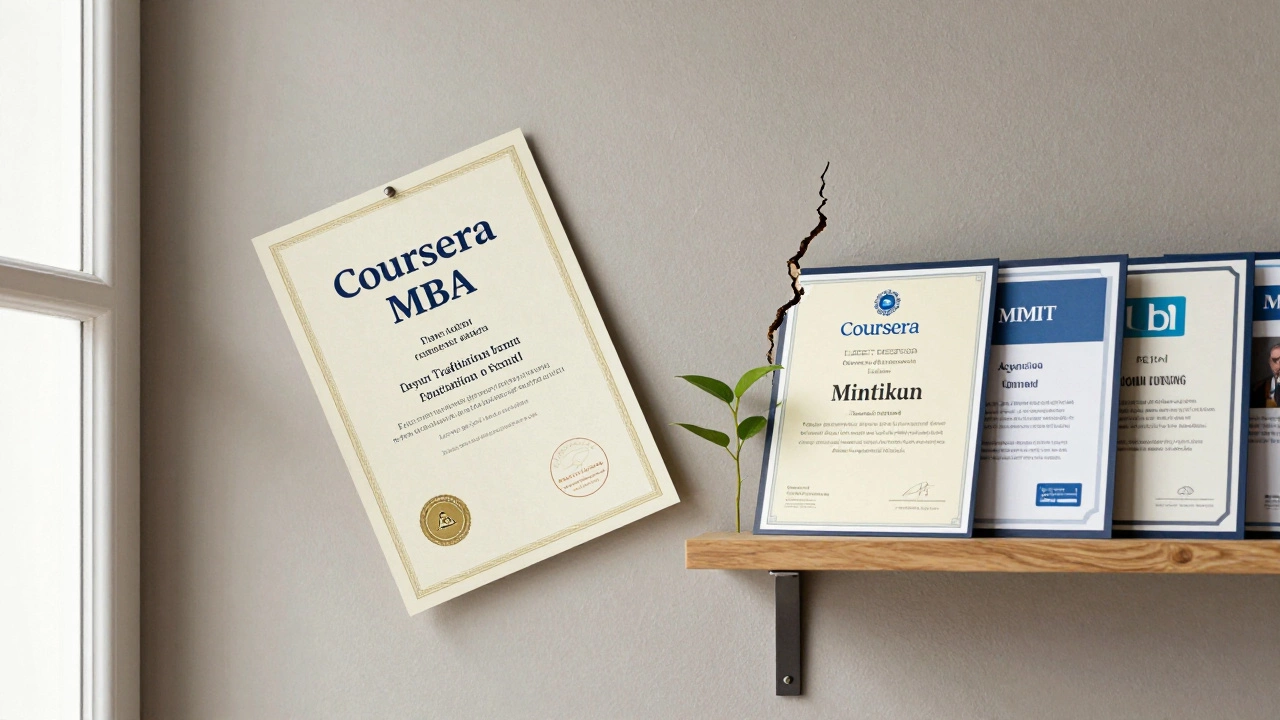
There are better, cheaper alternatives
You don’t need an MBA to learn strategy, leadership, or finance. Platforms like Coursera, edX, and LinkedIn Learning offer courses from top schools-often for under $500. You can earn a certificate in corporate finance from Wharton or leadership from MIT in 8 weeks, not 24. And you keep working while you learn.Some companies now sponsor certifications instead of degrees. Google, Amazon, and Microsoft all offer professional certificates that lead directly to roles. In fact, 40% of new hires at Google in 2025 came from certificate programs, not traditional degrees.
And if you want real-world leadership experience? Start a side project. Lead a volunteer initiative. Build a small team. Manage a budget. These are the skills that matter-and they cost nothing but your time.
Who still benefits from an MBA?
Let’s be clear: it’s not useless. For some people, it still makes sense. If you’re aiming for private equity, investment banking, or top-tier consulting, an MBA from a top school is still the gatekeeper. If you’re switching industries and have no relevant background, it can give you credibility. If you’re from a country where degrees carry more weight than experience, it might be necessary.But for most people-especially those in tech, creative fields, startups, or small businesses-the ROI just isn’t there. The risks are high. The rewards are uncertain. And the alternatives are faster, cheaper, and more practical.
If you’re thinking about an MBA, ask yourself: What am I trying to fix? A stagnant career? A lack of confidence? A need for credibility? There are better ways to solve those problems than spending $150,000 and two years of your life.
Is an MBA still worth it in 2026?
It depends on your goals. If you’re targeting finance, consulting, or corporate leadership at a legacy firm, then yes-it’s still a key credential. But for most other paths-tech, startups, entrepreneurship, marketing, or operations-it’s rarely worth the cost or time. Many professionals now build credibility through projects, certifications, and real-world results instead.
How much debt do MBA graduates typically carry?
The average MBA graduate in the U.S. and U.K. carries about $125,000 in student debt. At top schools, it’s often closer to $150,000. Monthly payments can exceed $1,200 for 10-15 years, depending on repayment plans. Many graduates delay buying homes, starting families, or investing because of this burden.
Do companies still value MBA degrees?
Large corporations in finance, consulting, and manufacturing still prioritize MBA degrees for leadership roles. But tech companies, startups, and digital-first businesses increasingly value skills, experience, and results over degrees. A 2025 LinkedIn survey found that 68% of tech hiring managers say demonstrable skills matter more than an MBA.
Can you get a good job without an MBA?
Absolutely. Many people land senior roles in operations, marketing, product management, and even executive leadership without an MBA. Companies are hiring based on track records-not diplomas. Building a portfolio of successful projects, leading teams, and demonstrating measurable impact often matters more than a degree.
What are the alternatives to an MBA?
Online certificates from Wharton, MIT, or Harvard (on platforms like Coursera or edX) cost under $500 and take weeks, not years. Professional certifications in project management (PMP), data analysis, or digital marketing are also highly valued. Real-world experience-leading a team, launching a product, managing a budget-often matters more than classroom theory.