
MBA True Cost & Time Calculator
Your Profile
Results Analysis
Enter your details and click Calculate to see the breakdown.
You’re staring at a tuition calculator, wondering if you can afford to pause your career for two years. Or maybe you’re juggling a full-time job and kids, asking yourself if there’s any way to get that degree without quitting everything. The short answer to how many years is an MBA? It depends entirely on the path you choose. While the traditional model locks you into a specific timeframe, the modern landscape offers options ranging from nine months to five years.
The length of your Master of Business Administration isn't just about calendar days; it dictates your opportunity cost, your networking window, and how quickly you can pivot your career. Choosing the wrong format can mean paying more in lost wages than the tuition itself. Let’s break down the actual timelines so you can match the program structure to your life right now.
The Traditional Two-Year Full-Time MBA
When people talk about an MBA, they are usually picturing the classic two-year residential program found at top-tier schools like Harvard, Stanford, or Wharton. This format has been the gold standard since the mid-20th century because it allows for a deep immersion into business theory and a massive expansion of your professional network.
Here is how the time actually breaks down. The first year is almost always rigid. You’ll take core courses in finance, accounting, marketing, operations, and organizational behavior. There is little room for electives here. The goal is to ensure every student, whether they come from engineering or humanities, speaks the same business language.
The second year is where you specialize. You pick electives, join clubs, and most importantly, participate in summer internships. That internship between year one and two is critical. It serves as a three-month trial run for post-graduation roles. Without this break, switching industries-like moving from consulting to tech product management-becomes significantly harder.
- Total Duration: 21-24 months.
- Commitment: 40-50 hours per week (classes + work).
- Best For: Career switchers, recent graduates with 3-5 years of experience, and those seeking maximum campus access.
- Opportunity Cost: High. You lose two years of salary and benefits.
If you are young enough to live on campus and want to completely reinvent your career trajectory, this is still the most effective route. But if you have a mortgage and dependents, the math might not work.
Accelerated and One-Year MBA Programs
In recent years, European business schools like INSEAD and IE Business School popularized the one-year MBA, and US schools have followed suit. These programs compress the curriculum by assuming you already know the basics. They cut out the fluff and focus intensely on strategy and leadership.
The trade-off is clear: speed versus depth. You won’t have that summer internship. You enter, you grind through classes for ten months, and you exit. This makes recruiting for new jobs much harder because companies prefer the longer evaluation period of a two-year student. However, if you are already established in your industry and just need the credential for a promotion or to start a business, the one-year MBA saves you a year of lost income.
Some US schools offer "accelerated" tracks within their two-year programs. If you have prior coursework in business or significant professional experience, you might test out of certain core classes, shaving off a semester. Always check if the school allows transfer credits or advanced placement before applying.
Part-Time and Evening MBAs
For professionals who cannot afford to quit their jobs, part-time MBAs are the practical solution. These programs allow you to work during the day and attend classes in the evenings or on weekends. The downside? It takes longer.
Expect to spend three to five years earning this degree. Why the wide range? Because life happens. You might take a lighter course load during a busy quarter at work, or you might take a semester off for family reasons. The flexibility is the feature, but it requires immense discipline. Procrastination turns a three-year plan into a six-year slog.
The social dynamic is also different. Your classmates are working professionals, which means the networking is highly relevant to your current job market. You aren’t learning from textbooks alone; you’re learning from peers who are solving real-world problems at companies like Google, JPMorgan, or local startups. However, you miss out on the immersive campus culture of full-time programs.

Executive MBAs (EMBA)
If you’ve been working for 10 to 15 years and are already in senior management, the traditional MBA feels too basic. Enter the Executive MBA. EMBAs are designed for leaders who need strategic insight but don’t need to relearn how to balance a spreadsheet.
The schedule is unique. Instead of weekly classes, EMBAs often meet on alternating weekends or in monthly modules. Some programs require international travel weeks. The total duration is usually 18 to 24 months. Your employer often pays for this degree because the skills you gain are immediately applicable to your current role. The ROI is immediate, unlike the delayed gratification of a full-time MBA.
Online and Hybrid MBA Options
The rise of high-quality online education has democratized access to top-tier business degrees. Schools like Indiana University Kelley, UNC Kenan-Flagler, and UT Austin McCombs offer fully online or hybrid MBAs that carry the same diploma weight as their on-campus counterparts.
Online MBAs vary wildly in length. Some asynchronous programs let you go at your own pace, potentially finishing in two years or stretching to four. Cohort-based online programs mimic the part-time structure, locking you into a 24-to-36-month timeline. The key advantage here is geography. You can study from anywhere, eliminating relocation costs. The disadvantage is the perceived lack of rigor in some circles, though this stigma is fading rapidly as more Fortune 500 leaders hold online degrees.
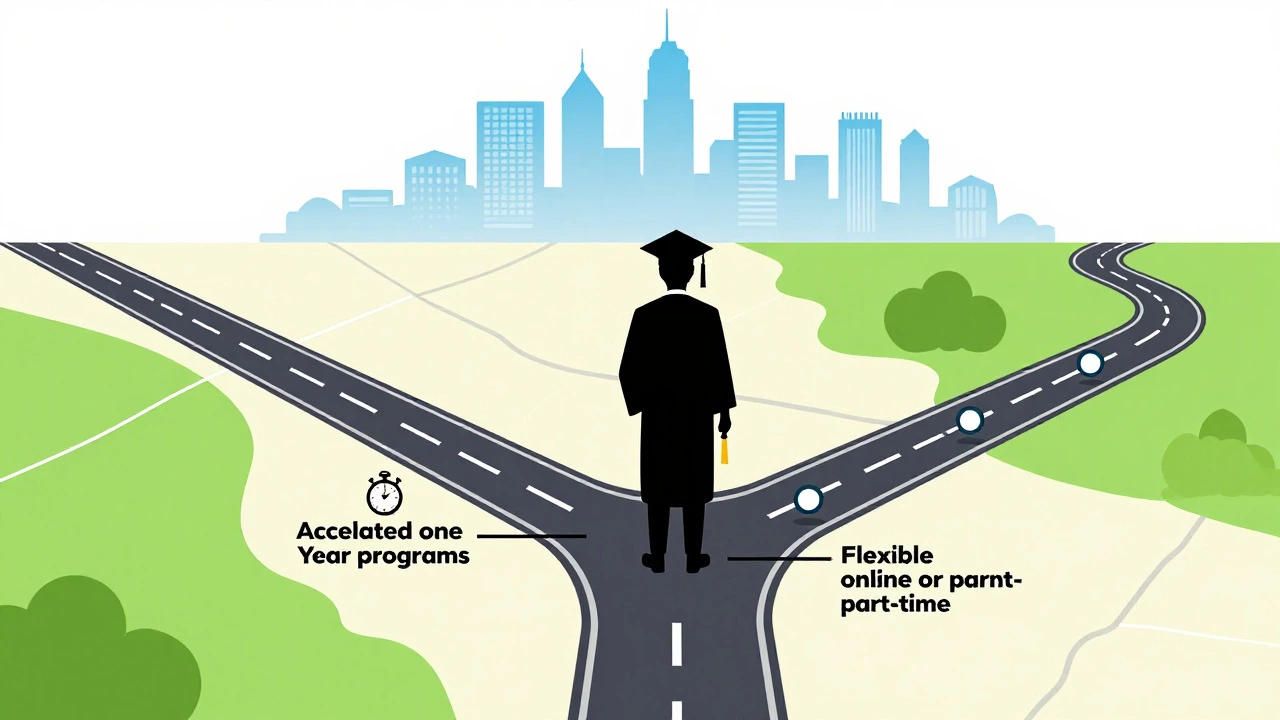
Comparison of MBA Formats
To help you decide, look at the hard numbers. Time is money, and in the context of an MBA, it’s the biggest expense.
| MBA Type | Duration | Schedule | Typical Candidate | Primary Benefit |
|---|---|---|---|---|
| Full-Time | 21-24 Months | Mon-Fri, Day | Career Switcher | Deep Networking & Internship |
| One-Year | 11-14 Months | Mon-Fri, Day | Experienced Professional | Speed & Lower Opportunity Cost |
| Part-Time | 3-5 Years | Evenings/Weekends | Working Professional | Keep Salary & Job |
| Executive (EMBA) | 18-24 Months | Weekends/Modules | Senior Leader (10+ yrs exp) | Strategic Peer Network |
| Online | 2-4 Years | Flexible/Async | Geographically Restricted | Flexibility & Accessibility |
Factors That Extend Your Timeline
Even within a set format, several factors can stretch your graduation date. Understanding these pitfalls helps you plan realistically.
- Thesis vs. Capstone: Some programs require a thesis, which involves original research and can add 3-6 months. Others use a capstone project, which is faster but less academic.
- Co-op Programs: Schools like Carnegie Mellon or Rochester offer co-op MBAs where you work for six months during the program. This extends the degree to three years but provides paid work experience.
- Double Degrees: Combining an MBA with an JD, MD, or MS adds significant time. An MBA/MHA might add a year, while an MBA/JD can add two.
- Academic Performance: Failing a core course means retaking it, which delays graduation. In rigorous programs, even maintaining a minimum GPA can be challenging while working full-time.
Calculating Your True Cost
When asking how long an MBA takes, you must also ask what that time costs. A two-year full-time MBA at a top school might cost $200,000 in tuition. But if your salary is $100,000, you are losing $200,000 in wages over two years. Plus benefits. The true cost is closer to $400,000.
A part-time MBA keeps your salary intact, making the financial risk lower, but the return on investment is slower. You won’t get the dramatic salary jump associated with career-switching graduates. Instead, you see incremental raises over time. Choose the format that aligns with your financial runway and career goals.
Can I finish an MBA in less than a year?
Yes, some intensive programs at schools like INSEAD or CEIBS can be completed in 11 to 12 months. Additionally, if you have significant prior business coursework or professional certifications, some universities may grant advanced standing, allowing you to skip core classes and graduate faster within a standard two-year framework.
Is a part-time MBA considered less valuable than a full-time one?
No, the diploma is identical. Employers generally do not distinguish between part-time and full-time graduates from the same institution. The difference lies in the experience: full-time students benefit from deeper campus immersion and dedicated recruiting cycles, while part-time students maintain their current career momentum.
Do online MBAs take longer to complete?
It depends on the program structure. Cohort-based online MBAs often mirror the 21-24 month timeline of full-time programs. Asynchronous programs allow self-paced learning, which can extend the duration to 3-4 years if you choose to take fewer courses per term to manage work-life balance.
What is the fastest way to get an MBA?
The fastest accredited route is a one-year full-time MBA, which takes approximately 11-14 months. Some accelerated online programs claim completion in 9-12 months, but verify accreditation carefully, as extremely fast programs may lack the depth and recognition of traditional institutions.
Can I pause my MBA program?
Most part-time and online programs allow leaves of absence due to health, family, or work commitments. Full-time programs are stricter but may permit a semester deferment. Check the specific academic policy of your chosen school, as prolonged gaps can sometimes affect visa status for international students.