
5-Word Phrase Practice Tool
Your Daily Phrase
Practice one of these essential 5-word phrases from the article. Start small and build confidence!
Your Phrase
How to Use
- 1. Click the phrase to hear pronunciation
- 2. Click "Practice This Phrase" and speak aloud
- 3. Your confidence grows with each practice
Remember: The article says "You don’t need a whole sentence. You need five words."
Most people who want to speak English don’t need perfect grammar. They need to be understood. If you’ve ever frozen mid-sentence because you couldn’t find the right word, you’re not alone. The problem isn’t your brain-it’s how you were taught. Schools focus on tests, not talking. But speaking English isn’t about memorizing rules. It’s about training your mouth, your ears, and your confidence-all at the same time.
Stop waiting for perfect English
You don’t need to know every verb tense to ask for coffee. You don’t need to pronounce ‘th’ perfectly to order a taxi. Most native speakers don’t care about mistakes-they care about understanding. A study by the University of Cambridge found that learners who focused on communication over accuracy improved their speaking speed 40% faster than those who tried to be perfect. Start speaking now, even if you sound awkward. The awkwardness fades with practice. The silence? That stays.
Try this: Say one thing out loud every morning before you check your phone. It could be, ‘I’m going to work today,’ or ‘The weather is cold.’ Just say it. Don’t write it. Don’t translate it. Say it. Do this for seven days. You’ll notice your mouth starts moving differently. That’s your brain rewiring itself.
Listen like you’re learning a song
You didn’t learn your first language by studying grammar books. You heard it over and over-songs, stories, people talking. The same works for English. But most beginners listen passively. They play English podcasts while cooking, then forget what they heard. That’s not learning. That’s background noise.
Active listening means repeating what you hear. Find a 30-second clip from a YouTube video or a podcast. Play it. Pause. Say it out loud, word for word. Try to copy the rhythm, the pauses, the tone. Do this three times. Then play it without pausing and try to speak along. You’re not trying to sound like a native speaker-you’re training your tongue to make unfamiliar sounds. This builds muscle memory.
Start with simple content: BBC Learning English’s ‘6 Minute English’ or the ‘Learn English with Emma’ YouTube channel. They speak slowly, clearly, and use everyday words. Avoid movies or news at first. Too fast. Too many unknown words. Build up slowly.
Use the 5-word rule
When you’re stuck, you don’t need a whole sentence. You need five words. That’s enough to get your point across. Think of English like building with LEGO. You don’t need the whole castle. Just a few pieces to make something recognizable.
Here are five-word phrases that work anywhere:
- ‘I need help with…’
- ‘Can you repeat that?’
- ‘What does this mean?’
- ‘I think it’s…’
- ‘Can I try?’
Practice these until you can say them without thinking. Use them in real life. At the store. On the bus. To a neighbor. Don’t wait for the ‘right moment.’ There is no right moment. There’s only now.
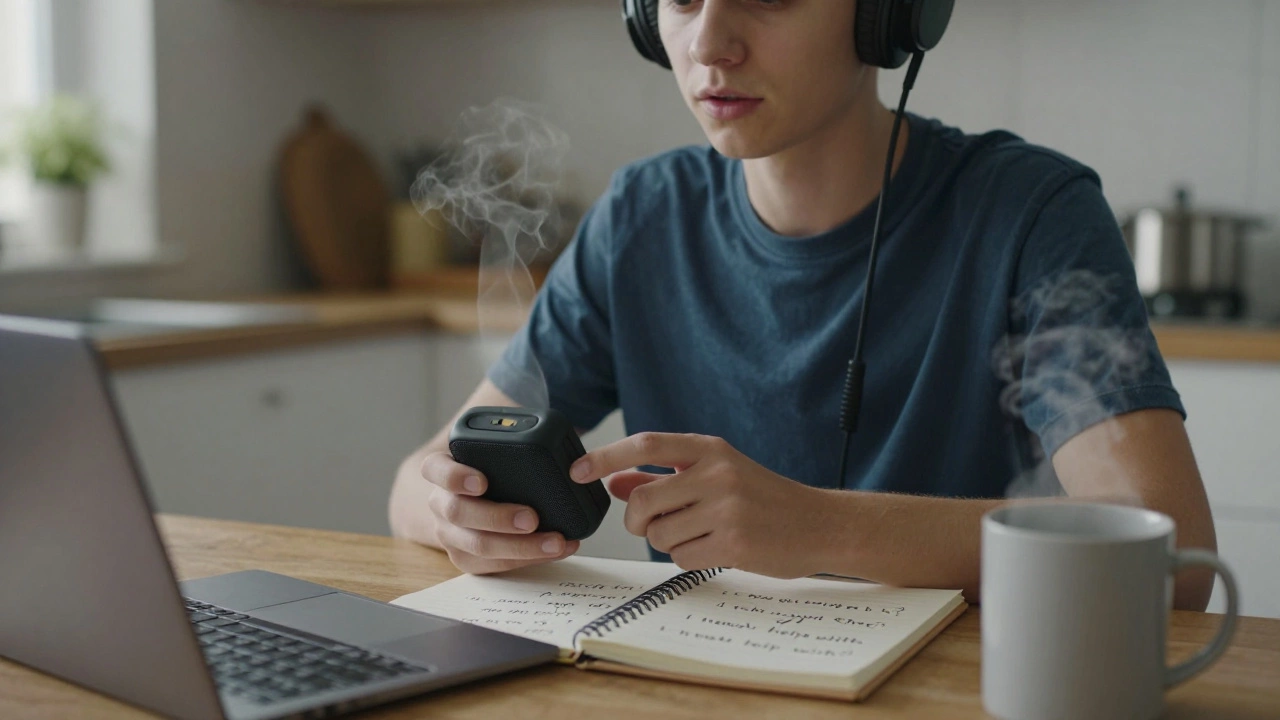
Find your speaking partner
Most people say they don’t have anyone to practice with. That’s not true. You just haven’t looked in the right places. There are free language exchange apps like Tandem and HelloTalk. You talk to someone learning your language. They talk to you learning theirs. No cost. No pressure. Just two people helping each other.
Or join a local meetup. In Manchester, there are weekly English conversation groups at libraries and community centers. You don’t need to be fluent. You just need to show up. One woman I know started going to a café group with only ten words. Six months later, she was telling jokes. She didn’t study. She just kept showing up.
If you can’t find a group, talk to yourself. Describe what you’re doing. ‘I’m making tea. The water is boiling. I’m adding sugar.’ Say it out loud. It feels silly at first. But your brain learns by repetition, not perfection.
Record yourself and listen
Most people hate hearing their own voice. But that’s exactly why you should do it. When you record yourself speaking, you hear what you actually sound like-not what you think you sound like. You’ll notice filler words: ‘um,’ ‘uh,’ ‘like.’ You’ll hear where you pause too long. You’ll hear where you mispronounce words.
Do this once a week. Say the same thing each time: ‘My name is ___. I’m learning English because ___.’ Record it on your phone. Listen back. Don’t judge. Just notice. Then try again next week. You’ll hear progress even if you don’t feel it.
One man I met in a language group used to record himself ordering food at restaurants. He’d play it back on the bus. After three months, his accent changed. Not because he tried to sound American. Because he listened to himself enough to fix the small things.

Speak before you’re ready
The biggest mistake beginners make? Waiting. Waiting to know more words. Waiting to be less nervous. Waiting for the ‘right’ time. But speaking isn’t something you prepare for. It’s something you do. And the more you do it, the easier it gets.
Set a tiny goal: Speak for 60 seconds every day. No script. No notes. Just talk. About your day. Your dog. Your favorite food. It doesn’t matter what you say. What matters is that you say it. After 30 days, you’ll realize you’ve been speaking English without realizing it.
People think fluency is a destination. It’s not. It’s a habit. Like brushing your teeth. You don’t wait until your teeth hurt to do it. You do it because it’s part of your routine. Same with English. Speak every day. Not because you have to. Because you want to understand-and be understood.
What to avoid
Don’t memorize long dialogues. You’ll forget them in real conversations.
Don’t translate in your head. It slows you down. Think in images, not words.
Don’t compare yourself to others. Someone who speaks faster isn’t better. They’ve just practiced longer.
Don’t wait for a class. The best teacher is your own willingness to try.
Don’t fear mistakes. Every native speaker made them. Every one. The difference? They kept going.
Start today
You don’t need a course. You don’t need a degree. You don’t need to be perfect. You just need to open your mouth.
Here’s your first step: Right now, say out loud: ‘I can speak English.’ Say it three times. Don’t whisper it. Don’t say it quietly. Say it like you mean it.
That’s it. You’ve started.
How long does it take to start speaking English?
Most beginners can hold a basic 2-minute conversation in 6 to 8 weeks with daily practice-just 15 to 20 minutes a day. The key isn’t time spent, but consistency. Someone who speaks for 10 minutes every day will outpace someone who practices for two hours once a week. Progress shows up in small wins: understanding a joke, asking for directions without panic, or ordering food without pointing.
Do I need to learn grammar to speak English?
Not to start. You learn grammar naturally by hearing and using the language. Think of it like driving a car-you don’t need to know how the engine works to turn the key. Focus on phrases and patterns first. When you make the same mistake repeatedly, then look up the rule. That’s when it sticks. Grammar helps you refine, not start.
What’s the best app to practice speaking English?
For beginners, Tandem and HelloTalk are the most effective because they connect you with real people who want to learn your language. If you prefer AI, ELSA Speak gives instant feedback on pronunciation. But no app replaces real conversation. Use apps to build confidence, then find someone to talk to. The goal isn’t to master an app-it’s to speak to a human.
I’m too shy to speak. What can I do?
Start by talking to yourself in the mirror. Then record yourself. Then say one sentence to a cashier or a neighbor. Shyness fades when you realize people aren’t judging you-they’re waiting to see if you’re friendly. Most people are happy to help. The more you speak, the less scary it becomes. You’re not failing-you’re practicing.
Can I learn to speak English without living in an English-speaking country?
Yes. Thousands of people speak fluent English without ever leaving their home country. What matters is exposure and practice. Watch English videos. Listen to English music. Talk to people online. Join a local group. Create an English environment where you are. You don’t need to move. You just need to use the language every day.