
JEE Main vs JEE Advanced: Eligibility & Strategy Tool
Enter Your Details
Analysis Result
Awaiting InputPlease enter your details to see if you qualify for JEE Advanced and get a tailored study plan.
Recommended Strategy
Action Plan:
You have spent years mastering physics formulas, chemistry reactions, and mathematics theorems. You are ready to prove yourself. But then you hit a wall of confusion: JEE Main or JEE Advanced? Which one matters more? Do you need both? It is easy to feel overwhelmed when two exams share the same name but lead to different doors. One opens the gate to National Institutes of Technology (NITs), while the other unlocks the prestigious Indian Institutes of Technology (IITs). Understanding the difference is not just about knowing dates; it is about strategy.
Think of JEE Main as the qualifying round for the ultimate prize. It is the first hurdle. If you clear it with a good rank, you get access to top engineering colleges across India, including NITs and IIITs. But if your dream is an IIT, JEE Main is merely the ticket to sit for the second, harder exam: JEE Advanced. This article breaks down exactly how these two exams differ in structure, difficulty, eligibility, and what they mean for your future career.
The Core Purpose: Screening vs. Selection
The fundamental difference lies in their purpose. The National Testing Agency (NTA) conducts JEE Main primarily to screen candidates. It acts as a filter. Millions of students appear for it, and only the top percentile qualify for the next stage. On the other hand, the Joint Seat Allocation Authority (JoSAA) uses JEE Main scores for counseling into NITs, IIITs, and GFTIs (Government Funded Technical Institutions).
JEE Advanced, however, is conducted by one of the seven zonal IITs on a rotating basis. Its sole purpose is selection for IITs. There is no other outcome. If you do not crack JEE Advanced, you cannot enter an IIT, regardless of how high your JEE Main score was. This makes JEE Advanced the definitive test of engineering aptitude for the country's most elite institutions.
| Feature | JEE Main | JEE Advanced |
|---|---|---|
| Conducting Body | National Testing Agency (NTA) | IITs (Rotating Basis) |
| Number of Attempts | Two attempts per year (Session 1 & 2) | One attempt per year |
| Eligibility | Class 12 passers or appearing students | Top 2.5 lakh rankers in JEE Main |
| Difficulty Level | Moderate (NCERT based) | Very High (Conceptual depth) |
| Question Pattern | MCQs and Numerical Value Questions | MCQs, Integer Type, Matrix Match, Paragraph Based |
| Primary Goal | Admission to NITs, IIITs, GFTIs | Admission to IITs, IISc, IIST |
Eligibility Criteria: The Gatekeeper Rule
Here is where many students make a critical mistake. You might think that scoring well in Class 12 guarantees you a spot in JEE Advanced. It does not. The rule is strict: only the top 2.5 lakh candidates from JEE Main are eligible to take JEE Advanced. This cutoff is determined by the All India Rank (AIR) in JEE Main. If you are ranked 250,001, you are out. Period.
Additionally, there are age and attempt limits for JEE Advanced that do not apply to JEE Main. For general category candidates, you typically have a limited number of attempts (usually two consecutive years) and an age limit (often under 20-21 years depending on the specific year's rules). JEE Main has no such restriction on the number of attempts within the validity period of your Class 12 results. This means you can keep trying JEE Main to improve your NIT rank, but your window for IITs is much narrower.
Syllabus and Depth: Breadth vs. Complexity
On paper, the syllabus looks identical. Both exams cover Physics, Chemistry, and Mathematics from Class 11 and Class 12. However, the depth required is vastly different. JEE Main questions are largely derived directly from NCERT textbooks. If you understand the concepts clearly and practice standard problems, you can score high. It tests your breadth of knowledge and speed.
JEE Advanced, conversely, tests your depth. The questions often combine multiple concepts from different chapters. A single problem might require you to use calculus in physics, thermodynamics in chemistry, and complex numbers in mathematics simultaneously. The questions are designed to be tricky, ambiguous, and time-consuming. They test your ability to think under pressure and approach problems from unconventional angles. It is not enough to know the formula; you must understand why the formula works and how it breaks down at the edges.

Exam Pattern and Structure
JEE Main is computer-based and offers two sessions. Your final rank is calculated based on the better of the two scores (normalized). Each session consists of three subjects, with 30 questions each. The pattern is straightforward: Multiple Choice Questions (MCQs) and Numerical Value Questions. There is usually negative marking for MCQs, but no negative marking for numerical answers.
JEE Advanced is also computer-based but is divided into two separate papers (Paper 1 and Paper 2). These papers are held on different days. To be considered for admission, you must qualify in both papers individually. The question types here are more varied. You will encounter Single Correct MCQs, Multiple Correct MCQs, Integer Answer Type, and sometimes Matrix Match or Paragraph-Based questions. The negative marking scheme is also more aggressive. Getting a multi-correct question wrong can cost you significant marks, so guessing is a dangerous game.
Scoring and Ranking Logic
In JEE Main, the NTA releases a percentile score. Because there are two sessions, they normalize the scores to account for difficulty variations between Session 1 and Session 2. Your final AIR is based on this normalized percentile. Since millions appear, even a small change in percentile can shift your rank by thousands.
JEE Advanced ranking is more direct but stricter. Your total score is the sum of your best valid paper scores. However, because the pool is smaller (only 2.5 lakh people), the competition is fiercer at the top. A difference of one mark can mean the difference between getting Computer Science at IIT Bombay and Mechanical Engineering at a lower-tier IIT. The normalization process here is internal to the IITs and ensures fairness across the two papers.
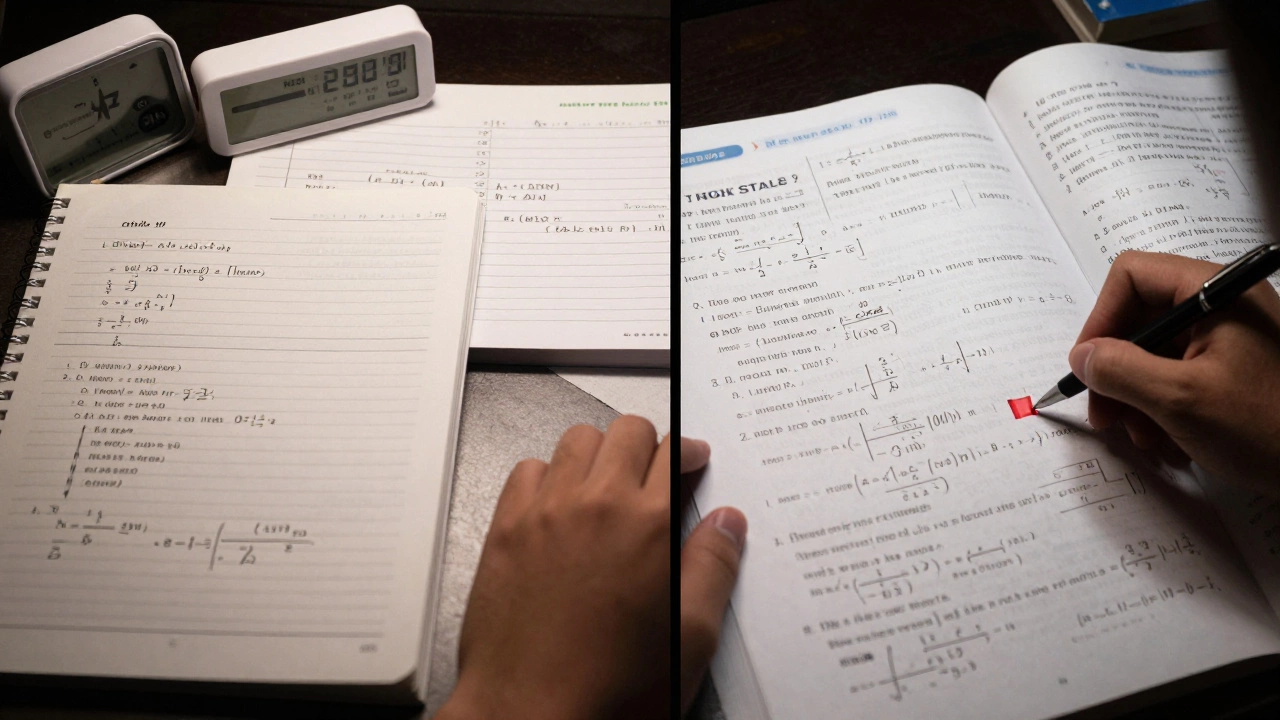
Strategic Approach: How to Prepare for Both
Since JEE Advanced requires you to clear JEE Main first, your preparation must be layered. In the beginning of your prep (Class 11 and early Class 12), focus on building strong conceptual foundations. Use resources that go beyond NCERT. Solve previous years' questions (PYQs) from both exams. Notice how JEE Main questions are faster, while JEE Advanced questions require deeper derivation.
As the exams approach, split your timeline. Dedicate the months leading up to JEE Main (usually January and April) to speed, accuracy, and covering the entire syllabus broadly. Take full-length mock tests to simulate the pressure of completing 90 questions in 3 hours. Once JEE Main is over, shift gears completely. Stop worrying about NCERT basics. Dive into advanced problem-solving books. Focus on integrating concepts. Practice the unique question patterns of JEE Advanced, like matrix matches and paragraph-based questions, which rarely appear in JEE Main.
Common Pitfalls to Avoid
- Ignoring JEE Main: Some students aim only for IITs and neglect JEE Main preparation. This is risky. If you fail to make the top 2.5 lakh, you lose your chance at IITs entirely. Plus, a good JEE Main score secures a backup option in NITs.
- Over-preparing for JEE Main: Conversely, some students stop studying after JEE Main, assuming they are safe. JEE Advanced requires a different mindset. You cannot coast on momentum alone. You need targeted revision for higher-order thinking skills.
- Negative Marking Fear: In JEE Advanced, the fear of losing marks on multi-correct questions leads to skipped questions. Develop a strategy to eliminate options confidently rather than avoiding tough questions altogether.
- Time Management: JEE Advanced papers are long. Many students run out of time. Practice solving difficult problems within strict time limits during your mock tests.
Frequently Asked Questions
Can I appear for JEE Advanced without giving JEE Main?
No. JEE Main is a mandatory prerequisite. Only the top 2.5 lakh rankers in JEE Main are eligible to register for JEE Advanced. There is no direct entry to JEE Advanced.
Which exam is more difficult, JEE Main or JEE Advanced?
JEE Advanced is significantly more difficult. While JEE Main tests speed and breadth of knowledge based on NCERT, JEE Advanced tests deep conceptual understanding, multi-topic integration, and problem-solving under extreme pressure.
Does my JEE Main score matter if I get a good rank in JEE Advanced?
For IIT admissions, only your JEE Advanced rank matters. However, your JEE Main score is crucial for securing seats in NITs, IIITs, and other government-funded technical institutions through JoSAA counseling if you do not get your preferred IIT branch.
How many times can I attempt JEE Advanced?
General category candidates can attempt JEE Advanced twice in consecutive years. Candidates from reserved categories (SC/ST/PwD) may have additional attempts or relaxed age criteria, subject to the specific rules announced by the conducting IIT for that year.
What happens if I qualify for JEE Advanced but do not take the exam?
If you are eligible but choose not to appear for JEE Advanced, you will not receive any rank. Consequently, you will not be considered for IIT admissions. You can still use your JEE Main rank for NIT/IIIT counseling.